PhD Journey: Sankofa – My Work in the World

To do that which is of value is eternity. And (a person) called forth by his (or her) works does not die –Seti I” (Karenga, 1984)

Many years ago, I began searching to understand who I am and what I am to contribute to the world, known as the “fundamental Fanonian [Franz Fanon] questions…’who am I; am I really who I am and am I all I ought to be’”(Karenga, 2004, pp. 268 – 269) My search began as a result of emotional and physical abuse in my first marriage and postpartum depression. After we separated, I was set adrift in the world unsure of my identity and without the skills to financial take care of myself. It was the lost of self that prompted me to begin studying psychology. My study of psychology was unique in that during that 80s and early 90s it was quite easy to take courses in a variety of subjects from a “black perspective” – including sociology, psychology, economics and literature. I also studied every self-help book I could get my hands on; I made affirmation tapes, and wrote volumes of journals.

The struggle to stabilize my financial life is what led to me to develop a tool that would reconnect me with my emotional-self and its relationship to how I express in the world in my personal relationships and my professional identity. Over time, I created a workshop initially called the ‘VisionBook” workshop, which is now known as the Asuwa[1] workshop.

My journey reflects of the concept “Sankofa” from the Akan people of Ghana, “there is no shame in going back to fetch that which has been forgotten”. It is literally through Sankofa that I do my work, as I am the co-founder and Executive Director of Sankofa Cultural Institute (SCI). Through our organization (which my second husband I started in 1997) I am able to offer wellness programs to the black community in Oakland. The main objective in doing my doctorate in transpersonal psychology is to develop my theory healing that will serve as the guiding principles of the Sankofa Wellness Programs. I am particularly interested in the intersection of cultural identity and the self-actualization.To find my way as an Ubuntu[2] psychologist, that in both my life and my work I: (1) recognize Spirit in all aspects of life, (2) appreciate people’s spiritual journey, (3) facilitate movement towards becoming one with the Creator, (4) help increase people’s strength from their experiences, (5) keep people aligned with their purpose and (6) acknowledge that people have purpose. (Washington, p. 37)

References

Karenga, M. (1984). Selections from the Husia: Sacred Wisdom of Ancient Egypt. Los Angeles: The Univerity of Sankore Press.

Karenga, M. (2004). Maat: The Moral Ideal in Ancient Egypt: A Study in Classical African Ethics: Routledge New York & London.

Washington, K. Zulu traditional healing, Afrikan worldview and the practice of Ubuntu: Deep thought for Afrikan/Black psychology.


[1] Asuwa is a Yoruba terms which means to fully actualize your essence in contribution to helping others realize their destiny

[2] Ubuntu concept is expressed in the African proverb ‘I am because we are”

Shadows and Song

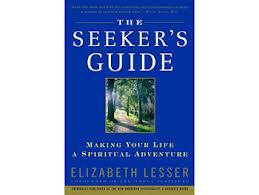
As I read Elizabeth Lessers’ book, I was reminded of my own spiritual journey and the significant role that my cultural identity has played. I realize that as part of this course we will write a spiritual autobiography, so I’ll try to restrain going into too much detail in this reflection paper.However, because her book is written in a semi-autobiographical format, I must share some of my personal thoughts. My intention is to shine a light on the shadows, so that I can more easily swim against the current of Western thought, and hopefully be able to relax a bit in the waves.

I will begin by saying that I appreciate the openness with which Ms. Lesser shares her experiences. She obviously has led a very spiritually rich life and has contributed greatly through her work at the Omega Institute. That said, one of my frustrations when reading these types of book is the universal “we” assumptions they make, and the one-sided views of history. For example Lesser states “our earliest ancestors were grappling with our own longings and questions…Cro-Magnon people had complex thoughts and deep feelings.” (p. 34) As a woman of African descent, I am not a part of this “our” as my cultural ancestors are not from Europe. (O’Neil, 2011) This does not mean that I am not a part of the human quest that is trying to understand the “mystery of creation”. I appreciate that she is sharing her search for a spiritual direction, however I think if your intention is to create an institution “where all thought converge(d)” to an “omega point”, then I expect the co-founder to acknowledge that the origins of humanity more.

So, I hope you can understand my irritation in reading a book that claims to be open to diverse spiritual perspectives, and yet you still have to deal with western-centric worldviews. For example, in recounting the founding of the Omega Institute for Holistic Studies she states, “as Pir Vilayat called his idea [it would] resurrect a concept of education put forth by the literary and scientific visionaries of ancient Alexandria in Egypt. Under the Ptolemies in the second century B.C….Alexandria was the enlightened center of the Hellenistic world.” In fact, this great African city and it’s museum and libraries began hundreds of years before the invasion of the Greeks and Ptolemy I. (James, 1954, pp. 49-50)

Occasionally, it would be nice to be able to simply read the text ‘like everybody else’ and not cringe each time people of color are mentioned or specifically, in the case of Alexandria –it’s African heritage is omitted. For me, one of the most frustrating things is when black people are portrayed in a two-dimensional fashion, such as violent/non-violent and, as an ahistorical people. Which is exactly what I experienced in reading “Book I: The American Landscape” when Lesser describes an encounter she had during her first years of college:

“I mistakenly got off the Barnard dorm elevator on the floor that a black students’ organization had demanded as their own. Walking down the look-alike hall toward a room I thought was mine, I was confronted by four girls I had seen on campus but had never dared talk to. “What are you doing on our floor?” they demanded. I suddenly realized my blunder and tried to explain it to them. Surrounding me, they pushed me toward the elevator. One of the girls grabbed me by my shirt collar and slapped me hard across the face as the elevator doors were closing. That slap woke something up within me, something that had been bothering me all year. I was ashamed of the mean-spirited rhetoric that pervade the anti-war movement…”


I have a number of concerns with how she describes this experience. First, the repeated use of the word “demanded” and that she was ‘confronted’, and never “dared” to talk to them. These “girls” (more on this later) are in fact college women, that with some research, I think where a part of the black students’ organization called the Barnard Organization of Soul Sisters (BOSS, established 1968) (Staff, 2003), Lesser doesn’t mention why the black organization was formed and why there was a need for having a ‘floor of their own’. When she reflects on the encounter she laments that “the great hero of nonviolence – Martin Luther King, Jr. – was dead, his message of tolerance and love no longer the unifying element of the civil rights movement.” However, King was more than a messenger of tolerance, he was black man that spoke truth to power. It is a commonly held belief in the black community, that it was his position on the Vietnam War that led to his assignation, as he was killed one-year later to the day (April 4th).

Dr. King was also more than a hero of nonviolence, he was someone that encouraged his people to not just sit and wait for their liberation from white oppression. Martin Luther King, Jr. called for black people to believe in themselves and “sign with a pen and ink of self-asserted manhood, [their] own emancipation proclamation” (King)

I suspect that like many Black people across the country, these young women were tired of what they may have perceived as white privilege, and the ‘mean-spirited rhetoric’ Lesser speaks of may have resulted from hundreds of years of oppression and disrespect from people who looked like her (Lesser). This is a lesson she had to be taught years later by Maya Angelou (p. 79-80). Yes, the slap “woke something that had been bothering her all year”; but it was probably delivered by someone who had been bothered much longer than that.

I am bothered too. I am bothered by the pain and suffering I see happening in the world, specifically here in Oakland, CA. My longing is to be an agent of transformation in my community and use the knowledge that I have from my studies of various spiritual traditions (western and others). I struggle with being able to read past the cultural limits of many of the authors of transpersonal and new age materials; I want to be compassionate and graceful in my critic of the literature. Like Lesser, “I yearned to speak from the depth of my heart, to educate, to fill in the missing parts of the story – to sing.” I too have “held back my songs and my tears many times. (p. 77) Hopefully, as I continue on my journey, I will be able to find the right balance of tones through my mindfulness toolbox.

References

James, G. (1954). Stolen Legacy: Greek Philosophy is Stolen Egyptian Philosophy. Trenton: African World Press, Inc.

King, M. L. (Producer). MLK that’s never quoted. Retrieved from http://www.youtube.com/watch?v=HlvEiBRgp2M

O’Neil, D. (2011), from http://anthro.palomar.edu/homo2/mod_homo_4.htm

Staff. (2003). African America History Month at Barnard.Retrieved from http://barnardarchives.wordpress.com/2010/02/03/african-american-history-month-at-barnard/

Recent Post for my Intro to Transpersonal Theory course

This is my response to reading the article: Transpersonal Psychology: Defining the Past, Divining the Future by Glenn Hartelius, Mariana Caplan, and Mary Anne Rardin/California Institute of Integral Studiesas always comments are welcome!

Reference:

Hartelius, G., Caplan, M., Rardin, M. A. (2007). Transpersonal psychology: Defining the past, divining the future. The Humanistic Psychologist, 35(2), 1-26.


Summary:

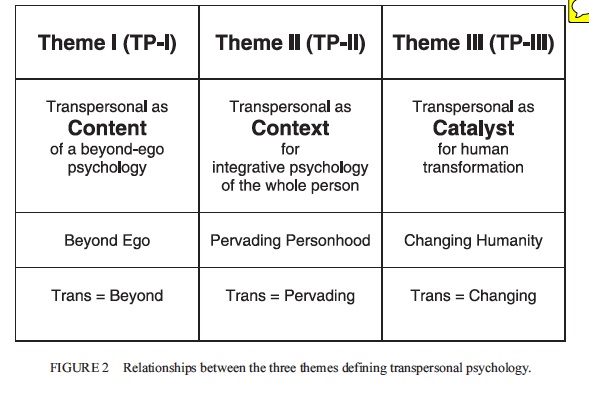
In this article Hartelius, Caplan and Rardin conduct a retrospective analysis of definitions published doing the 35 years history of transpersonal psychology. Their research suggests the major subject areas of the field can be summed up in three themes: beyond-ego psychology, integrative/holistic psychology, and psychology of transformation.


Excerpts and Comments:

“While transpersonal psychology still needs to embody the inclusiveness and diversity that it represents, its vision is one of great relevance to the contemporary human condition.” (p. 1)

I continue to be both surprised and pleased with the acknowledgment of the need for more voices to be heard in the field of transpersonal psychology. I was hopeful that this would be the case. It’s one of the reasons I choose this area of focus; it seemed to me that because of the openness to other ways of knowing, that it would be a space that would offer me an opportunity to bring my full self to my scholarship.
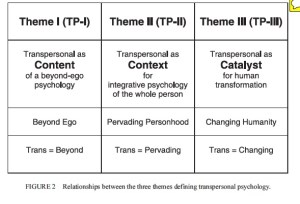

“transpersonal as context covers more than the beliefs, attitudes, and intentions (and, we would add, the somatic presence) of the therapist in relationship to a client. It refers also to the recognition that ego is not separate from its many contexts, that it must be seen within the larger fabric of the embodied mind, the community, the social history, the environment, and the transpersonal ultimate. In addition,Western psychology lives and breathes within a global net of culture-specific psychologies, some of which take

forms unfamiliar to this society, but all of which inform an inclusive human psychology.” (p. 10)

I completed my Bachelor’s degree at the California Institute of Integral Studies (2010), one of the features of the program was learning how to have an integral approach to education – and by extension psychology and other fields. Similar to ITP, CIIS is rooted in a East/West construct. At CIIS I found this to very limiting. Fortunately, ITP seems to a bit more open to the “global net of culture-specific psychologies”. Of the three themes presented in this article, the one that most closely aligns with African-centered theory, is TP-II – the integrative psychology of the whole person/transpersonal as context. For the same reason, I’m also interested in TP-III – catalyst for human transformation, as this one suggests that is has some similar objectives of Ifa. In this African-rooted tradition, it is through each person fulfilling there personal destiny (orì) and alignment with their soul (emi); thereby developing good character (iwà-pelé) that humanity (ènìyàn) will be able to obtain a “good position” including freedom of fear and death.

“Wilber’s critique of transpersonal psychology is not so much a comment on

its popularity as an assessment of its relevance… has transpersonal psychology become

the truly inclusive human psychology that its definition implies?” (p. 17)

During the retreat I was asking myself if I’d made the right decision in choosing ITP and more specifically transpersonal psychology. My concern was how can I use what I’m learning at ITP in service of my community; a community of Black people, living in America – specifically women. Is transpersonal psychology only for upper -and middle- class white folks trying to find themselves through transcendent experiences by way of the appropriation of indigenous practices? To be honest, I’m not sure yet; it’s only week 2 and so far I’m feeling that transpersonal psychology is indeed more than a “cultural artifact from the psychedelic sixties” (p. 17)

“There is as yet only minor participation from Asia, Africa, or South America; even when such voices exist, they have at times been overlooked (see, for example, an Afro-centric approach to multicultural psychology: Bame, 1997; Mphande & Myers, 1993; Myers, 1985, 1994, 2005;Myers, Kindaichi, & Moore, 2004, Spight, Myers, Cox, & Highlen, 1991). If transpersonal psychology aspires to be a fully integrative human psychology, a psychology that is not only East-West but also North-South, it will need to invite voices from the rest of the world.” (p. 17)

I could not have said it better. I’ve met Dr. Linda J Myers, she is an Elder in the Association of Black Psychologist, and along with Stan Grof; she will be a keynote speaker at next years’ Regional Student Circle Conference (which is being sponsored in part by ITP). I referenced her article (Myers, 1985) in my application letter. I think that one of the reasons other voices have not been welcomed is because it would require a sort of ‘come to Jesus’ moment. The ‘west’ will no longer be able to hide behind liberal rhetoric and claims of color-blindness with declarations of openness because of their embrace of the ‘east’. Additionally, the ‘north-south’ peoples have learned that by raising their voices they may and have loss (or never offered) tenure, face being labeled radical, racist, and/or irrational.

“The West cannot do this for the world; it can only do it with the world. The growing transpersonal community could benefit greatly from transpersonal associations throughout Asia, Africa, and Latin America—not so Westerners might come as missionaries and teach the transpersonal, but because the Western community needs the participation of these communities if there is to be a larger conversation. This means doing more than inviting others to add their voices to an agenda that has been written in the West. Transpersonal psychology itself may grow and shift, perhaps in profound ways, as other members of the human community bring their gifts and contributions.” (p. 17/18)

Often people think that to find non-western worldviews one must leave the borders of the US and travel across land and sea. This simply is not true. In the case of Asian and Latin cultures all one must do is visit the local “Chinatown” or “Barrio” to witness not only the symbolic attributes like food and music, but if you are a close observer, you may also see their spiritual and psychological worldview through traditional celebrations and family values. For African descended people, on the surface it may seem a bit more challenging. However, every Sunday morning you can find African-rooted transcendent experiences at just about any Black church. In fact, just this past weekend I participated in an African-rooted transpersonal practice at public park in West Oakland. Additionally, I have a library full of books that chronicle the long history of African psychology – most of which have written by African American scholars. One of my favorites is by Dr. Wade Nobles, African Psychology: Toward Its Reclamation, Reascension and Revitalization. (Nobles, 1986). And, although I’ve not it yet finished it, would also recommend the book Ethnicity and Psychology: African-,Asian-, Latino-, and Native-American Psychologies by Professor Kenneth P. Monteiro, San Francisco State University. (Monteiro, 1995,1996)

.

References

Monteiro, K. (1995,1996). Ethnicity and Psychology: African-, Asian-, Latino-, adn Native-American Psychologies. Iowa: Kendall/Hunt Publising Company.

Myers, L. J. (1985). Transpersonal Psychology: The Role of the Afrocentric Paradigm. Journal of Black Psychology, 12(31). doi: 10.1177/009579848501200103

Nobles, W. (1986). African Psychology: Toward Its Reclamation, Reascension & Revitalization. Oakland: A Black Family Institute Publication.
My PhD Journey

Greetings all,
Today completed
the first week of my doctoral program at the Institute of Transpersonal Psychology. Because I’m doing my degree online, all of our assignments are posted via the school ‘virtual campus’ program Angel Learning System.

So, I thought I could begin sharing some of my ‘posts’ with my community through this blog. I will start with my response to one of the reading assignments from my Spiritual Perspective class; an article by Angeles Arrien entitled: Discovering the Universal Journey.
…………..
……………

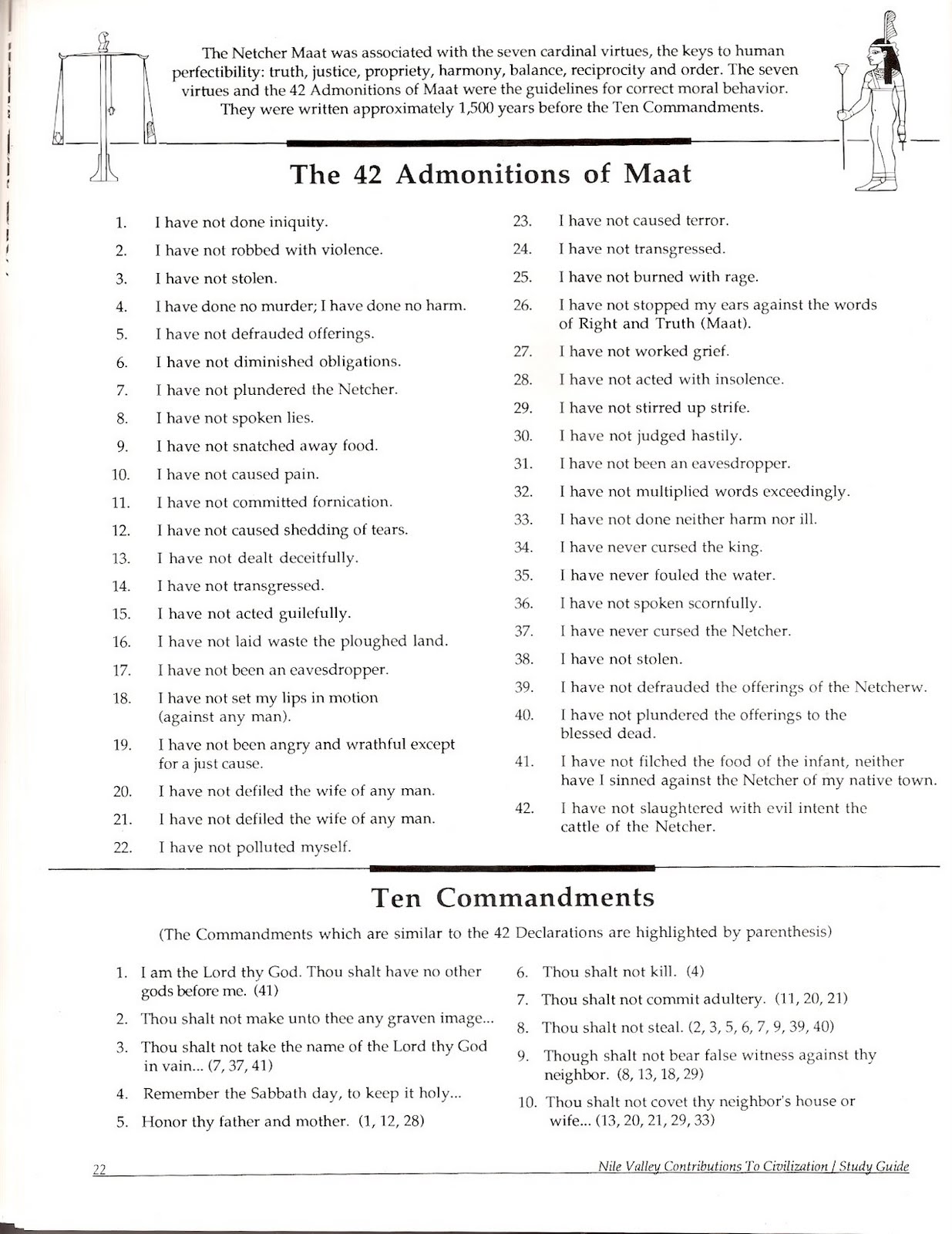
When Arrien asks if the Ten Commandments are universal, my first thoughts return to the ancient teachings from Kemet (Egypt). Which is where you find what many scholars believe are the original inspiration for the Ten Commandments.

“The Netcher* Maat was associated with the seven cardinal virtues, the keys to human perfectibility: truth, justice, propriety, harmony, balance, reciprocity and order. The seven virtues and the 42 Admonitions of Maat were the guidelines for correct moral behavior. They were written approximately 1,500 years before the Ten Commandments” (Browder, 2000, p. 22) A detailed comparison can be found in the book Nile Valley Contributions to Civilization. (Browder, 2000) *a Netcher is a deity. The cardinal virtues of Maat played an important role in my own spiritual development. Especially during my twenties when I was trying to figure out how to live my life in a more self-actualized manner (more on this in future posts).

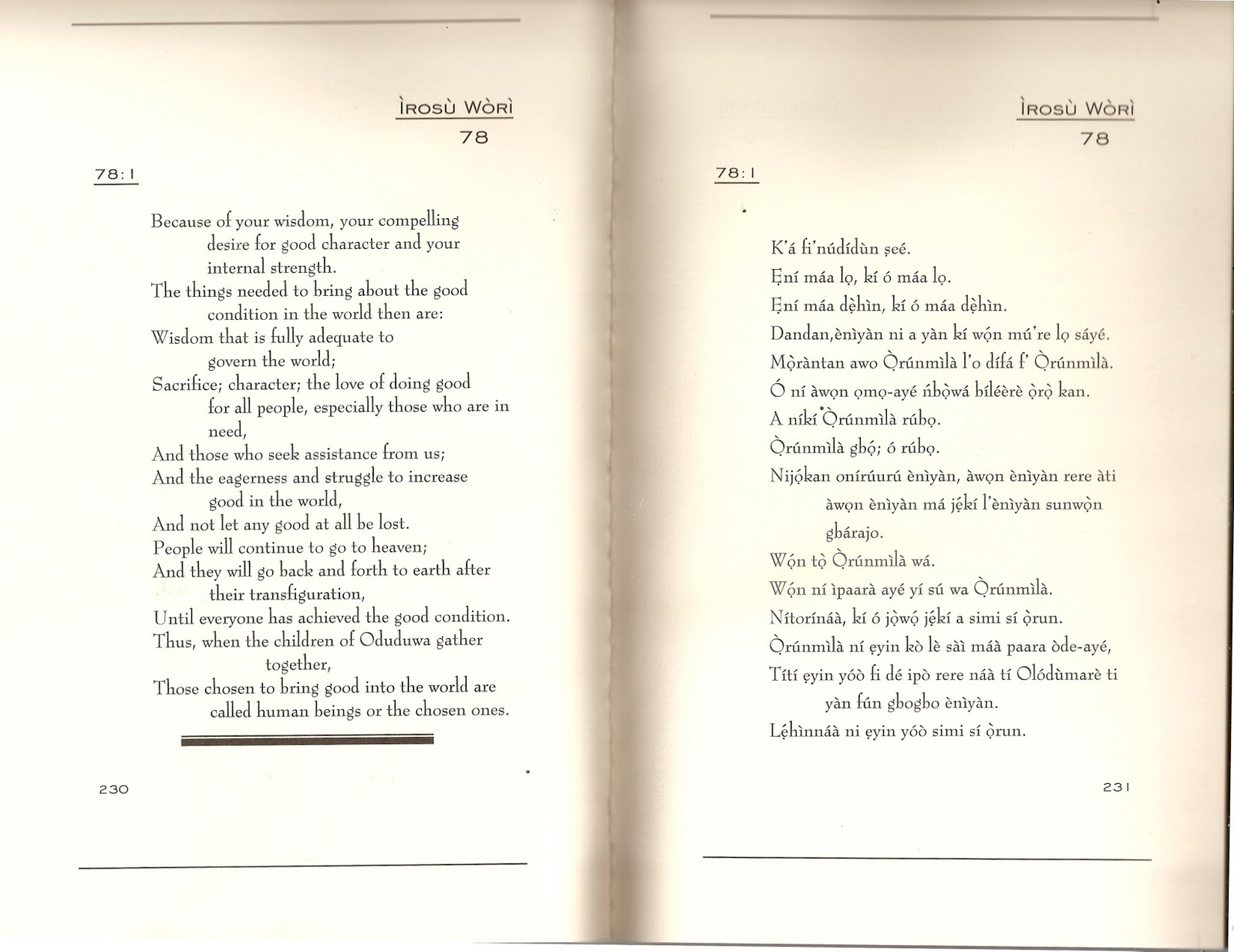
I greatly enjoyed reading the Ten Oxherding Pictures with Commentary and Verses. I particularly liked how it showed the journey of coming into what is sometimes called Christ Consciousness or living Buddha. It reminded me of another ancient text, this one from the Yoruba people in Nigeria called the Odù Ifá which dates back thousands of year. There is one story in particularly of three friends that journey to earth; I’d like to share it, but unfortunately I don’t have the reference. So, instead I thought it would be fitting to mention one of our great scholars Dr. Maulana Karenga who published a book entitled: Odù Ifá: The Ethical Teachings. (Karenga, 1999) In it he’s selected Odù (divine stories) that have an ethical message.

I won’t go into detail here (as I’m already way past my 200 words), but each Odù has a number and name. In the case of the one I want to share, it would be 78:1 Ìrosù Wòrì. I’ve attached it as a PDF. Basically, it tells of what is needed to bring good into the world. Perhaps it speaks to what Arrien says are “themes or issues that concern us as a species and …begin to uncover what has ‘meaning’ for us in our species-hood” (p. 3)

References
Browder, A. (2000). Nile Valley Contributions to Civilization: Exploring The Myths – Volume 1 Study Guide. Washington, DC: The Institute of Karmic Guidance.
Karenga, M. (1999). Odù Ifá: The Ethical Teachings Translation and Commentary, A Kawaida Interpretation. Los Angeles: University of Sankore Press.

Sankofa: an African-Centered Approach to Culture & Community

Be not arrogant because of your knowledge. Take counsel with the ignorant as well as with the wise. For the limits of knowledge in any field have never been set and no one has ever reached them. Wisdom is rarer than emeralds, and yet it is found among the women who gather at the grindstone.
– the Book of Ptah-Hotep from the Husia (M. Karenga, 1984)

INTRODUCTION AND DESCRIPTION OF MY FIELD OF INQUIRY
This Field Reader is being done in direct response to the Summer 2010 Cohort-B, course section: Culture and Community curriculum. I am aware that this is an unconventional approach to creating a reader. However, I was so agitated by my experience, and given my work outside of school, I felt it was my duty to create a counter-or alternative reading options for the course. This reader will take an intentionally afri-centric focus. I will attempt to offer options in response to the novels, articles and other readings that in my opinion had a neo-colonist, ahistorical epistemological slant in its view of Black people, whether on the continent of Africa, in Americas or Europe.

I’ve attached is a link to the full document and would love to hear your feedback and input.

Attunement for 2010

Here are my Sacred Six priorities for 2010:

  1. School
  2. Spirit
  3. Self Care
  4. Sankofa Cultural Institute
  5. Coaching and Consulting practices
  6. Duane’s Business Manager

Specifically I will:

  • complete my BA degree at California Institute of Integral Studies (begin Jan/ graduate Dec)
  • complete two semesters of French at Laney College
  • complete two semesters of Yoga at Laney College
  • continue providing Coaching & Business Support Services – this includes Moon Circles and VisionBook Workshops.
  • get my “Warriors”
  • begin offering programing for Sankofa Cultural Institute (Portuguese language clubs, Jazz symposiums)
  • support Duane as his business manager
  • eat mainly “live food”
  • release 50 pounds
  • grow out my ‘fro
  • go to bed by 11PM and rise at 6AM
  • take sacred baths at least once a week
  • wheat, gluten & caffeine free

I am now creating success in an easy and relaxed manner, in a healthy and positive way. I am now living the life of my dreams in a easy and relaxed manner, in a healthy and positive way. I am now doing what I love to do in an easy and relaxed manner and in a healthy and positive way. I am sensible and in control of my finances. I am creating total financial success in a easy and relaxed manner and in a healthy and positive way. I am now living the my dreams in any easy and relaxed manner and in a healthy and positive way. (quoted from Marc Allen)

Releasing my inner Catwoman

Catwoman. I love this movie. I know, I’m the only one, but so what. I love it so much, that I’ve watched more times than I can count. I also plan to write an essay about it. But in brief, one of the things I love about it is the relationship between the women. I particularly enjoy the wise women role of Ophelia. It is she that Patience Phillips (Catwoman) turns to for guidance in her journey. Patience is concerned that she has lost herself in the transformation. But, Ophelia tells her not to fear, because she is a part of long line of “Catwomen.” By accepting who you are, all of who you are, you can be free and freedom is power –
I often feel this duality. I struggle between what I think I should be and my true nature. I long to release my inner Catwoman and liberate myself.

Our Deepest fear is not that we are inadequate. Our deepest fear is that we are powerful beyond measure. It is our Light, not our Darkness, that most frightens us. We ask ourselves, who am I to be brilliant, gorgeous, talented, fabulous? Actually, who are you NOT to be? You are a child of God (a catwoman) Your playing small does not serve the World. There is nothing enlightening about shrinking so that other people won’t feel unsure around you. (So crack your whip..) We were born to manifest the glory of God that is within us. It is not just in some of us: it is in everyone. As we (wear our catsuit) and let our own Light shine, we unconsciously give other people permission to do the same. As we are liberated from our own fear, our presence automatically liberates others (meow) -Marianne Williams, with a little help from Catwoman

Who is Dwanimen?

I have a had a different name for each phase of my life. When I was born, the name at the top of my adoption papers read Baby Girl Walker; by the bottom it was Aretha Mae Brown. Aretha Brown was a happy care-free girl. When I got married at 18 yrs old, my name changed to Aretha Mae Nelson. After a couple years of marriage, Aretha Nelson was a overwhelmed wife and mother. When I divorced, it returned to Aretha Mae Brown; by then she was a depressed confused young women.

After years of emotional and financial struggle, when I turned 30, I changed it to Adeeba Malika Bashir. Adeeba was tired, but hopeful. I married Duane ten years ago and I became Adeeba Dwanimen Deterville. For the last decade I’ve been creating her. Adeeba Deterville the nonprofit/corporate professional, co-founder of Sankofa Cultural Institute, Duane’s wife. Adeeba Deterville is frustrated and unfulfilled.
 
I took on the name Dwanimen ten years ago too. The thought was that she would be the grounded, wise-woman me. My “bachelorette party” was part bridal shower, part naming ceremony. It was my second attempt at naming myself. I’d tried it before with taking on Adeeba. But instead of focusing on Dwanimen, I focused on Adeeba/Deterville. But Dwanimen never left me.
 
So, now at 47 and a half, I’m finally embracing Dwanimen. Who is Dwanimen. I ask myself, what does she smell like, how does she wear her hair? What kind of work does she do? Does she eat vegan/raw? What kinds of books does she read. Does she travel? What languages does she speak? How does she spend her time? How does she express in the world?
 
Here’s some of my vision of her. Dwanimen’s presence is calming and healing. She flows. She smells like amber, sandalwood and patchouli. She radiates coolness. She is like the colors of autumn. She is the rich harvest season. Creamy like Kailua, smooth like cognac. Simple, easy, relaxed. She’s like dark chocolate mixed with cayenne pepper. She is me.

Me, myself and I

I love taking personality tests. I’ve done Meyers Brigg, Strength Finder, Enneagram, you name. One of the things I like is the consistency in how I show up. I was raised as an only child by two loving older parents. In my late teens I found out I had been adopted when I was just 3-weeks old. People often ask me how I felt when I first learned I was adopted; my first response was one of deep gratitude, my second was remorse.

I was very thankful to my parents for loving me in spite of me. I was your typically spoiled daddy’s girl, with little discipline. Boy, I was hard on my mom. They LOVED me.


Also, I often wondered why I didn’t “feel” connected to my parents, grandmother or other relatives. I always felt different. As a Black teenager in the 70s, I loved both Barry Manilow and Parliament Funkadelic – I still do! I lived in what would be considered a low-income neighborhood, but because of the age of my parents (my dad was a War World II vet) I lived a very comfortable working-class lifestyle. My parents owned their home, I had a swing-set in the backyard and took piano classes at USC school of music.


I think that in my quest to feel connected, and to figure out who I am, I began taking personality tests. As I said, I’ve taken most of the popular ones. Here are the results of a few:

What does all this say about me? For me it says, a rose by any name is still a rose.