Hammons and Deterville: Black Male Expression

David Hammons (United States, Illinois, Springfield, born 1943) Injustice Case, 1970 Print, Body print (margarine and powdered pigments) and American flag, Sheet: 63 x 40 1/2 in. (160.02 x 102.87 cm) photo © 2011 Museum Associates/LACMA

David Hammons (United States, Illinois, Springfield, born 1943)
Injustice Case, 1970
Print, Body print (margarine and powdered pigments) and American flag, Sheet: 63 x 40 1/2 in. (160.02 x 102.87 cm)
photo © 2011 Museum Associates/LACMA

Since deciding to focus my research for this course on Black male intimacy and jazz, I have begun to reflect more broadly on Black male bodies expressing themselves around issues that are important to them by looking at the performative aspects of Black male artistic expression. Root-Bernstein (2001) describe the body thinking of Jackson Pollack, “Each canvas is, therefore, a record of his movements, an action painting. If you do not feel the physical sensations involved in Pollock’s artistic process, then you do not understand his art” (p. 165). As I read this what came to mind was the artist David Hammons, who’s work I saw at a show in Los Angeles called “Now Dig This”. David Hammons is an African American artist who amongst other processes, is known for using his body to create his art (see images below). Hammons body art was created during the earlier 1970s as part of the Black power movement. Hammons would cover has skin with Crisco oil (a cooking oil that was frequently used in Black households) and press body against the canvas to form impressions that he would then modify by sprinkling pigment and graphite to create pieces that spoke to issues like black male incarceration and stereotypes about the black male body.

Dikenga Variation 2From the previous weeks reading, Observing (Root-Bernstein, 2001, pp. 30-49) although I found the writing to be a bit repetitive, I really enjoyed reading this chapter. It seemed to be describing what is now referred to as visual culture. I have personal experience with the benefits of observing the world through eyes of an artist. My husband is a visual artist and has a Master’s degree in Visual and Cultural Studies. I asked my husband D. Deterville (personal communication, October 18, 2013) to describe visual culture: “Visual culture is the broadened field of art history that takes into consideration – not just fine art expression – but all of the phenomenons that occupy the visual field. Visual culture is about multiple ways of seeing and the ways in which culture is constructed by those different modes of visuality”.It has been through my relationship with my husband Duane, that my appreciation and understanding of how to observe has been expanded. Two examples of this is through my participating in his creation of a series of twenty-seven ground drawings in which he would do rubbings from common objects – manhole covers, street grates, and ornamented doors. Using these rubbings as a base, he would then create profound works addressing spiritual and political themes. I’ve attached three images – two focused on the Kikongo (Congo cosmology) concept of life, birth, death and one that pay tribute to the Black Panther Party using a play on Yoruba religious symbols. In the creation of the pieces Duane would knell on the street – often at night, with me holding a flashlight and watching for cars and cops.

Reference:
Root-Bernstein, R.S. & Root-Bernstein, M.. 2001. Sparks of Genius: The Thirteen Thinking Tools of the World’s Most Creative People. Houghton Mifflin Company

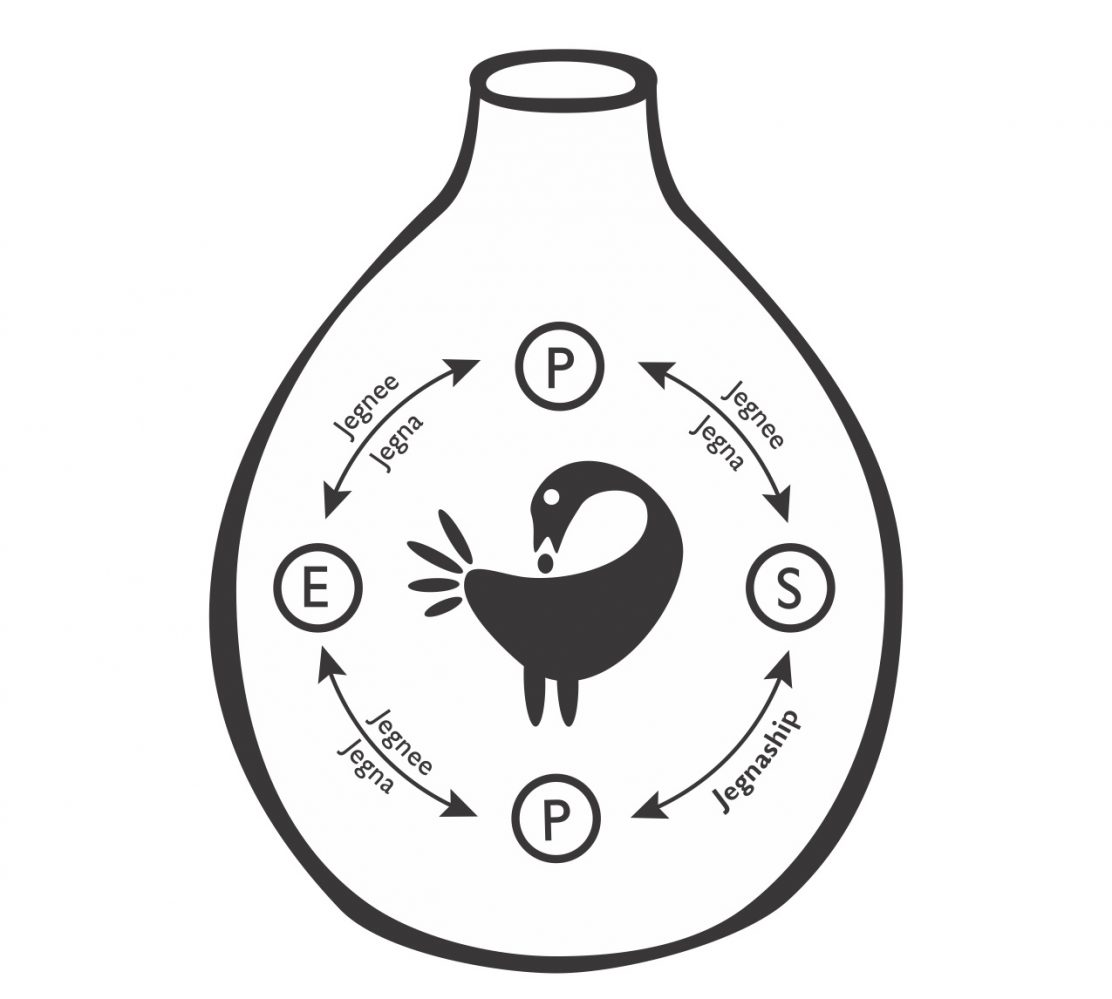
The Connection between Self-based African-Centered Spirituality and the Transpersonal Concept of the Self

…from the Yoruba people of West Africa there is a plethora of psycho-spiritual self-based concepts found within the traditional religion Ifá. The concept, aṣùwà – full actualization of one’s essence and orì ire, which address the state of one’s consciousness being properly aligned with one’s destiny are two examples that are focused on the actualization of the self through lived experience

This paper explores the African roots of transpersonal psychology and the importance of spirituality in the development of African-centered transpersonal self. It builds upon the work of Louchakova and Lucas (2007) that addresses the need for transpersonal psychology to develop a congruent clinical theory of the transpersonal self. They note that transpersonal theorists from Maslow to Ferrer have failed to agree on a conceptualization of the transpersonal self (p. 113). Therefore, this paper seeks to add to discussion by exploring the connection between self-based African-centered spirituality, its African-centered psychology counterpart the indexical self, and how these concepts can inform transpersonal psychology’s concept of the self. The long term goal of this initial research is to explore the notion of the transpersonal self and its practical application in the lives of African-American women to live a more fully actualized life through the development of an African-centered transpersonal self.

Louchakova and Lucas postulate that the absence of a transpersonal clinical category of the self is due to transpersonal psychology’s lack of examination of culture-related processes. Louchakova and Lucas note the need for transpersonal psychology to move beyond the bias of “western, male-centered versions of the world’s spirituality” (p. 118). Specifically, they call for transpersonal psychology to be more inclusive of representatives of indigenous spiritual systems, noting the African-American scholar Asante (1984) as a rare example of inclusion of an African ascendant voice in the transpersonal discourse.

Asante is a seminal figure in Afrocentricity (1984; 1990; 2003), which is a method of examining African phenomena. Afrocentricity and its contemporary expression Africalogy are central concepts that frame the theoretical notions underlining this paper. Asante (1990) defines Africalogy as “the Afrocentric study of phenomena, events, ideas, and personalities related to Africa.” (p. 14). The term Afrocentric is used primarily in the humanities and cultural studies fields. The social sciences tend to use the term African-centered. For this paper the terms African-centered and Africalogical will be used interchangeably. As noted by Louchakova and Lucas (2007) twenty-eight years ago, Asante (1984) detected the near absence of the African worldview in transpersonal psychology. A year later, when Myers (1985) conducted a survey of articles in the “Journal of Transpersonal Psychology” from approximately 1974 – 1984, she observed that an exploration of traditional African culture and worldview was noticeably missing. The review confirmed that the transpersonal paradigm mostly focused on “Oriental philosophy and modern physics” (Myers, 1985, p. 32).

To contextualize transpersonal concepts from an African-centered perspective, this paper explores the African roots of transpersonal psychology’s ancient psychospiritual lineage. Bynum (1992) states that awareness of transpersonal concepts such as transcendence, mysticism, and cosmic oneness were explored in Africa in the ancient land of the blacks – Kemet, which is now known as Egypt. The ancient Kemetic Egyptians wrote about “seminal ideas on the dynamics of death and resurrection, divine judgement [sic] and retribution, encountering the luminous spirit, the dynamic transformations of personal consciousness into the divine consciousness, the holy trinity and even the story of the Kristos” (p. 302). Bynum notes, “The psychological knowledge of these peoples included the awareness of the dynamic unconscious”, thereby developing a “transpersonal perspective on the unconscious” (p. 303).

Bynum (1992) reminds us of the cross-fertilization between the ancient Egypt, Ethiopia and Kundalini Yoga-rich Dravidian India via the trade routes; exchanging religious ideas and psychospiritual disciplines (p. 302). Bynum’s overview of transpersonal psychological concepts encompass not only the past, but the future by advocating for the field of study to move beyond its preoccupation with Eastern and Western methods. Bynum advises, by looking back to African mysticism and African notions of the unconscious transpersonal psychology “will open to the Personalism dimension inherent in many forms of ancient African mysticism and the African unconscious” (p. 305).

Transpersonal psychology’s narrow focus on the East constitutes a missed opportunity to learn from African concepts of wholism and consciousness like the Sudic Ideal – ideological harmony (Asante, 1984, p. 168). The ultimate task of ideological harmony (Sudic Ideal) is “to realize the promise of becoming human” (Asante, 1984, p. 168), which is the essential task of the person; for this to happen individual and collective harmony is primary (Asante, 1984, p. 170). Myers (1985) points out that the transpersonal paradigm goal of unity and integration of knowledge or a “system of interconnection” (p. 33) is already extant in the African worldview. Myers (1985), like Bynum (1992), and Asante (1984) call for future researchers to use an African-centered paradigm as a method to structure concepts of consciousness. Consciousness being the first of the four aspects of the transpersonal model of a person (Walsh & Vaughan, 1980, p. 12). For one to begin to understand consciousness from an African-centered perspective, one must understand the role of spirituality.

Spirituality, as opposed to religiosity is central to African-centered perspective therefore, it is important to define the term spirituality and its distinction from religiosity. Mattis (2000) endeavors to identify the definitions of spirituality by African American laywomen and to differentiate spirituality from religiosity. Mattis’ study takes an ethnographic approach in order to root the study in the subjective experience and perspectives of African American women. Mattis (2000) states, “African American people make complex distinctions between spirits that exist as a part of the religious realm (e.g., God) and those that exist within the secular realm of life (e.g., ancestors)” (p. 101). This is a particularly important distinction because from an Africalogical worldview, African people “do not conceive of themselves as separated from the cosmos but as being completely integrated into a universe [which includes both secular and non-secular realms] that is much larger than any of them and yet is centered around them” (Mazama, 2002, p. 220).

Mattis (2000) provides a variety of meanings of spirituality, including the biblical reference; breathe of God as well as interpretations from contemporary psychology, metaphysics, and sociology. She states that spirituality influences the way “individuals perceive interpret, and respond to their world(s) as well as significant social others” (p. 104). According to Potts (as cited in Mattis, 2000) “spirituality is a ‘belief that there is a sacred force that exists in all things’” (p. 104). Mattis notes that this definition argues for the “transcendent nature of spiritual existence” (p. 104); declaring Potts’ observation is important because it brings about a link between spirituality and sanctity.

African-centered scholar, Thomas (2001) defines spirituality as a distinct personal concept whereas religion is a shared experience with a group of people. Spirituality often corresponds to a universal concept, while religion tends to be about concrete expressions. Thomas declares, “There seems to be a connection between spirituality and mental health, psychological functioning, and wellness” (p. 2). Thomas notes that an African-centered spiritual worldview emphasizes the importance of a life force, accentuates unity, and connectedness of humanity to a Higher Power, to each other, and to nature.

From a transpersonal perspective, Grof (2008) points out the critical need to make the distinction between spirituality and religion. Grof defines spirituality as “direct experience of non-ordinary aspects and dimensions of reality” (p. 50) that are not in need of mediated contact, or an officially appointed person or special place. As an example, Grof notes that indigenous mystics experience their own divinity in their bodies and through nature (p. 50). However he fails to mention that their embodied divine experience occurs within a cultural phenomenon. This is an important oversight because transpersonal psychology tends to disembody indigenous psycho-spiritual practices and, as Louchakova and Lucas (2007) point out, spiritual experiences and ontological assumptions are not disconnected from the self – culture, spirituality and the self are linked.

Louchakova and Lucas (2007) argue that it is time for transpersonal psychology to explore gender, ethnicity, and culture, but to do so would require transpersonal psychology to develop a concept of the transpersonal self – which as previously noted, the field has yet to do. Louchakova and Lucas boldly ask if transpersonal psychologists are afraid to “examine the self, because being too person-centered will damage our work?” (p. 111). Asserting that for the field to develop a concept of the transpersonal self would require transpersonal psychology to move away from universalism and toward relativism and cultural construction. The discipline of transpersonal psychology would need to acknowledge that spiritual universalism is not invincible; as such, universalism would be significantly eroded by the cultural construction argument.

Washington (2010) states, “The assertion has been, within the European context, that what Europeans do is the norm for all people. They are universal and thus the prototype of all people” (p. 30).
Acknowledging that the Eurocentric convention of seeing itself as the universal standard is flawed, Louchakova and Lucas (2007) state, “What it means to be a human being is not the same ‘wherever we go’” (p. 116). They ask an important question regarding culture, the mind, and spirituality. Positing that if culture and mind constitute one another; thereby informing cross-culturally diverse patterns in higher-level mental processes, and if human development at large is the function of these influences, why then should spiritual development be exempt from the construct of transpersonal self? They point out that because transpersonal psychology studies the mind beyond the ego, consequently the sense of the individual “I” is poorly defined, and therefore the field lacks a clinical category of the self. Stating, that the “non-duality-oriented transpersonal rationalist” (p. 123) have a difficult time with the spiritual connotations and devotional attitude of self-based traditions.

Louchakova and Lucas (2007) consider the impact of self-based and no-self-based spiritual traditions on the development of the transpersonal self. To help understand the underpinnings of the self, Louchakova and Lucas look at how self-based and no-self-based spiritual systems differ in the experience of ultimate reality. Asserting that the lived experience of ontological indivisibility and non-duality of the ultimate reality differs greatly in self-based and no-self-based traditions (p. 123). Specifically, no-self traditions see internal reality as egalitarian and homogenous, while self-based traditions emphasize the “organization of the living self including its internal hierarchical ordering (Louchakova, 2005a) and the inner interrelatedness of its constituents…” (p. 124). Thereby, self-based traditions emphasize a decrease of ego and an increase of self so that the “living self is transformed rather than increased” (p. 126).

Transpersonal psychology’s theoretical emphasis on no-self-based Eastern traditions limits the inclusion of self-based African-centered spiritual traditions. This emphasis may be why the African voice has been neglected in the discourse on the development of the transpersonal self. Louchakova and Lucas (2007) offer an overview of self-based and no-self-based traditions, noting that Buddhism is an example of a no-self tradition, where as spiritual customs such as Tantra, Vedanta, Sufism, and Christian mysticism posit the ontological value of selfhood. “Self-based traditions imply that the attainment of the ultimate reality during one’s embodied existence requires a transformation of the understanding of the self, leading to non-dual perception” (Louchakova & Lucas, 2007, p. 123). African-centered traditions such as the Yoruba-rooted traditions Ifá and its Diasporic variations Lucumi (Afro-Cuban), Santeria (Cuban/Puerto Rican), Candomblé (Brazilian), and Vodun (Haitian), as well as the Akan theory of the person as described by Grills and Ajei (2002) – are examples of self-based African-rooted spiritual traditions. It is worth noting, that all of these traditions are currently practiced in the United States.

As a way for transpersonal psychology to more comfortably consider self-based traditions, Louchakova and Lucas (2007) suggest associating the “understanding of egological and non-egological forms of self in spiritual traditions” (p. 125), thus allowing the traditional transpersonal theorist “to proceed with more discretion in transpersonal theory building” (p. 125). By extension, the African-centered concept of indexical- and referential self could also be a pathway to unfolding the transpersonal self. Landrine (1992) provides an in-depth description of the indexical self and referential self concepts and their application in a clinical setting. Landrine states that “The ‘referential self of Western culture is construed as an autonomous entity defined by its distinctiveness and separateness from the natural and social world” (p. 403).

Landrine (1992) identify two types of indexical self concepts: the indexical self as social role – which is found in sociocentric cultures, and the indexical self as illusion or receptacle, where self is understood as a vessel for immaterial forces and entities; both of which are found within many African-rooted self-based psycho-spiritual traditions. A good example of indexical self as receptacle is found in the practice of spirit possession – which is central feature in all of the Yoruba-rooted traditions referenced above. In Candomblé, an Afro-Brazilian religion developed primarily by enslaved Yoruba, Aja-Fon, and Bautu peoples from West and Central Africa – incorporates veneration of ancestors, spirit possession of deities known as Orixas, and initiation ceremonies. Candomblé continues to be employed as an African psycho-spiritual method for healing. DeLoach and Petersen (2010) state that Candomblé provides “a model and means for understanding and treating the physical, psychological, and spiritual health of its devotees …” (p. 44). DeLoach and Petersen continue, “The process of initiation, for example is the process of joining with the cosmic energy of one’s Orixa; a process of mutual acceptance” (p. 44). It is a lived experience of cosmic unity. For the initiate and broader Candomblé community, individuals engage in spiritual intervention and restoration.

Another example of a self-based psycho-spiritual tradition is that of Ubuntu from the Zulu people of South Africa. It is an African construct that defines what it is to be a person, where being a person is both particular, and a task of self-realization (Brooke, 2008, p. 49). Ubuntu is a person’s internalized sense of community, their sense of responsibility toward others, both living and dead, and toward the wider world at large (Brooke, 2008). Ubuntu is also an example of a social role and receptacle indexical self. Two central scholars in application of Ubuntu are Washington (2010) and Brooke (2008). Washington (an African-American scholar) takes a distinctly African-centered approach by framing Ubuntu as an African system of healing that is part of African/Black Psychology. Brooke, a white South African scholar views Ubuntu through a Jungian lens of individuation, and sees it as part of a multicultural analytical psychology.

Washington (2010) describes the self from Ubuntu Psychology perspective “as being an expression of the Divine and is thus divine. All humans come from one divine Source and are at the same time an expression of that divine Source” (p. 35). He continues, “Relative to this notion that self is divine is the idea that Ubuntu Psychology adheres to the notion of universal consciousness or Soul” (p. 35). This universal consciousness of the divine human spirit “is always in connection with a Divine source within the universe. One then is able to connect with multiple dimensions of the universe because the universe is all and is multi-dimensional” (p. 35).

Brooke (2008) offers a nuanced view of Ubuntu via a Jungian lens and his concept of individuation – “with its emphasis on separateness and the withdrawal of projections, is essentially modern and Western” (p. 36). Jung’s psychoanalytic model being the first transpersonal psychology (Cortright, 1997) is important especially in light of Jung’s travels and studies in Africa. By way a of critique of Jung’s colonialized perspective of the African psyche, Brookes notes “With regard to individuation, for instance, Jung’s concept is so thoroughly [Western] cultural that it all but forecloses the possibility of individuation for people of color, especially in Africa” (p. 39). Brooke bridges Jung and Ubuntu by exploring the concept of African consciousness called negritude from the philosopher, poet, writer Leopold Senghor, the former President of Senegal. Paraphrasing Senghor, Brookes writes, “[Negritude consciousness] is the whole network of civilized values…which characterize the Black peoples, or, more precisely, the Black African world. All these values are informed by an intuitive reason – consciousness – that involves the whole person” (p. 48). Brooke notes the Jungian undertones in Senghor’s work. Brooke sees the concept of Ubuntu as an “important counterpoint to Jung’s view of the social world” (p. 48). Brooke’s defines Ubuntu as something that was given to all “because we are human, but its realization is a spiritual task that requires personal resoluteness, moral courage, and the support of others who treat us as persons”(p. 49), thus reemphasizing the connection between self, spirituality and community – the indexical self. Regardless of which lens Ubuntu is viewed through – be it African-centered or Individuation, it could serve as a valuable transpersonal model of the self.

Lastly, as mentioned, from the Yoruba people of West Africa there is a plethora of psycho-spiritual self-based concepts found within the traditional religion Ifá. The concept, aṣùwà – full actualization of one’s essence and orì ire, which address the state of one’s consciousness being properly aligned with one’s destiny are two examples that are focused on the actualization of the self through lived experience. Although there are numerous books and traditional knowledge on orì ire and aṣùwà, a cursory review of various databases, has not yet revealed any peer-reviewed articles that focus specifically on these topics. These two concepts are primary topics in the research interests of this author. As a practitioner of Ifá/Lucumi and budding transpersonal researcher, she is keenly interested in exploring these psychospiritual concepts of the self in depth. It is the intention of this author to conduct a preliminary phenomenological study on the transpersonal aspects of African-centered Black women healers. The study will examine the role of African-centered spirituality as it relates to the development of their transpersonal self and their psycho-spiritual well-being – to discern if and how these factors inform their healing practices. Additional research will also look at cultural constructionism and feminist theory as suggested by Louchakova and Lucas (2007) to explore their application to African-centered spiritual traditions.

In summary, Africalogical concepts are important to transpersonal psychology because they offer the field an opportunity to expand beyond its East/West paradigms, thereby allowing transpersonal psychology to embrace a neglected, but no less imperative cultural view in the fields’ ongoing quest to develop the notion of the transpersonal self. This paper endeavored to reflect upon the African roots of transpersonal psychology to show the need for their contemporary inclusion. It examined the importance of spirituality in the development of African-centered transpersonal self by exploring the role of spirituality in the African-centered concept of the self/personhood. Encouraging the field to move beyond spiritual universalism.

Building upon the work of Louchakova and Lucas (2007) and Landrine (1992) this paper explored the connection between self-based African-centered traditions, its African-centered psychology counterpart the indexical self, and how these concepts can inform transpersonal psychology’s concept of the self. To see how these concepts can be useful in understanding African-centered notion of self, the paper explored the African-rooted concepts of indexical-self in Candomblé and Ubuntu. This paper observes that there remains a dearth of research on African-centered psycho-spiritual traditions within transpersonal psychology literature in general and specifically regarding self concepts found in Yoruba-rooted traditions. There appears to be a critical gap in the field – the African voice. There is much that the transpersonal field can learn from African ontology, beliefs, ethos, and traditions (cosmology), and value (axiology). This paper affirms that the lack of attention given to African-centered self-based traditions has contributed to transpersonal psychology’s ongoing challenge with developing a definition of the transpersonal self.

References

Asante, M. (1984). The African American mode of transcendence. Journal of Transpersonal Psychology, Vol 16(2), 167-177.
Asante, M. K. (1990). Kemet, Afrocentricity, and knowledge: Africa World Press.
Asante, M. K. (2003). Afrocentricity: The theory of social change: African American Images.
Brooke, R. (2008). Ubuntu and the individuation process: Toward a multicultural analytical psychology. Psychological Perspectives, 51(1), 36-53. doi: 10.1080/00332920802031870
Bynum, E. B. (1992). A brief overview of transpersonal psychology. The Humanistic Psychologist, 20(2-3), 301-306.
Cortright, B. (1997). Psychotherapy and spirit: Theory and practice in transpersonal psychotherapy: State University of New York Press.
Grof, S. (2008). Brief history of transpersonal psychology. International Journal of Transpersonal Studies, 27, 46-54.
Landrine, H. (1992). Clinical implications of cultural differences: The referential versus the indexical self. Clinical Psychology Review, 12(4), 401-415. doi: 10.1016/0272-7358(92)90124-q
Louchakova, O., & Lucas, M. (2007). Transpersonal self as a clinical category: Reflections on culture, gender, and phenomenology. The Journal of Transpersonal Psychology, 39(2), 111-136.
Mattis, J. S. (2000). African American women’s definitions of spirituality and religiosity. Journal of Black Psychology, 26(1), 101-122. doi: 10.1177/0095798400026001006
Myers, L. J. (1985). Transpersonal psychology: The role of the afrocentric paradigm. Journal of Black Psychology, 12(1), 31-42. doi: 10.1177/009579848501200103
Walsh, R. N., & Vaughan, F. (1980). Comparative models of the persons and psycholotheraphy. In S. Boorstein (Ed.), Transpersonal psychotherapy (pp. 12-27). Palo Alto, CA: Science and Behavior Books, Inc.
Washington, K. (2010). Zulu traditional healing, Afrikan worldview and the practice of Ubuntu: Deep thought for Afrikan/Black psychology. The Journal of Pan African Studies, 3(8), 24-39.

Continue reading

The Concept of Destiny (orì) and Alignment (ire) and Individuation as Understood in Yoruba Cosmology and its Role in African American (Women) Psychological Congruence

Here is an excerpt from a recent paper:
 
The African culture that Jung saw was a cultural transference fantasy, a reflection of the organizing images within the collective consciousness of the early 20th-century educated European. With regard to individuation, for instance, Jung’s concept is so thoroughly cultural that it all but forecloses the possibility of individuation for people of color, especially in Africa. Individuation is the guiding term in analytical psychology; Jung’s Collected Works can be read as elaborations of that central theme. (Brooke, 2008, p. 39)
 I will explore the notion of identity congruency for people of African descent; specifically women, by looking at the Yoruba concept of Ori Ire – “one’s who’s consciousness in aligned with their destiny” and how it compares to Jung’s individuation. I am interested in this topic for two reasons. First, is my personal experience as a mid-life African American woman whose quest for psychological congruence has provided me with a sense of transpersonal development. Secondly, this research seeks to advance the discipline of Africalogy (Bankole, 2006). Africalogy utilizes Afrocentric theory created by Molefi Asante, it serves to unite African diaspora and Black (African-American) studies (Bankole, 2006, pp. 664-665)
 
The conceptual basis for my research is the work of Wade W. Nobles, particularly as found in his book Seeking the Sakhu: Foundational Writings for an African Psychology (Nobles, 2006a), and his essay, “To be African or not to be: The question of Identity or authenticity – Some preliminary thoughts” Nobles places himself “in the tradition of an Nkrumah Pan Africanist, a Malcolm Black Nationalist, a Garvey race man, and a Fanon revolutionary” (p. xxxi). Elder/founder of the Association of Black Psychologists, Nobles is professor emeritus in the Department of Africana Studies, the School of Ethnic Studies at San Francisco State University and Chief Priest of Ifá and Ghanaian traditions. His spiritual traditional name is, Nana Kwaku Berko I-Ifabemi Sangodare. 
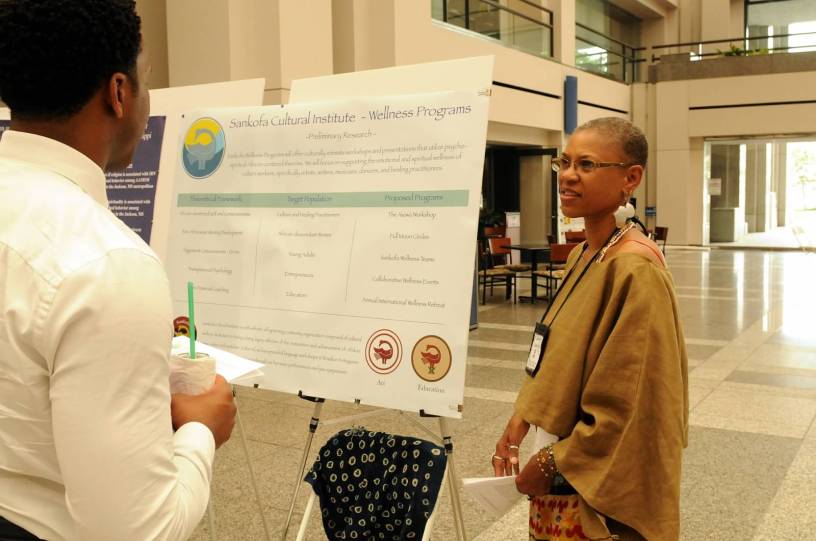
My research is significant because it may be the first study of its kind to address the use of the Yoruba concept of orì ire for people who are not devotees of the religion, Ifá. My topic is relevant to transpersonal studies, because it is centered in the application of pycho-spiritual principles. It is practical because the outcome is to create wellness programs for my nonprofit organization, Sankofa Cultural Institute.
Individuation – African Perspectives
In my research, I have come across two examinations of Jung’s theory and how it relates or contrasts with African notions of self, identity, and consciousness. Roger Brooke (2008) is a white South African scholar and author of numerous books and articles on Jung and analytical psychology, psychological assessment, and psychotherapy. Awo Fa’lokun Fatunmbi (1992) is an Ifá high priest and author of several seminal texts on Ifá (Yoruba tradition) and Santeria/Lucumi (its Cuban variation). He is a white American man initiated into the faith in 1985.
            
As mentioned, the Zulu term Ubuntu is a common awareness found in African communal societies. “Ubuntu is a term that defines what it is to be a person, where being a person is both a given and a task of self-realization” (Brooke, 2008, p. 49). Self-realization from an African humanist perspective is Ubuntu. African humanism, evoked by the term Ubuntu, would imagine individuation as a process of personal growth and transformation within that network of relationships that make such transformation possible and to which the person remains, therefore, ethically indebted. (Brooke, 2008, p. 49) For Jung however, individuation has “an emphasis on the withdrawal of projections…Separate-ness is the key to the process” ((Brooke, 2008, p. 39). Fatunmbi (1992) outlines the Ifá concept of psychology.  by discussing several key concepts, including Odù, orì, iporí, orì inú, and orì ibi.

Each of these Yoruba concepts relate to the development of consciousness, psychological congruence, and destiny. Fatunmbi begins with the concept of Odù defined as, “the energy patterns that create consciousness” (p. 16). He states that it is “analogous to what Carl Jung called archetypes of the collective unconscious” (p. 16). Fatunmbi continues,
“Jung believed that there exists a set of primal patterns that form the content of self perception and place the self in relationship to the world. According to Jung, these patterns remain abstract until the unconscious gives them a cultural and personal context”. (p. 17)
— end excerpt —

Jung’s theory of Individuation and its Relationship to the African Concept of Self and Consciousness

This is an excerpt from my final paper for Theories of Personality class…


Introduction

This paper was to focus on Jung’s theory of Individuation as it is presented in the textbook Personality and Personal Growth (Frager & Fadiman, 2005) and how it relates to the African concept of self and consciousness in the essay African-Centered Conceptualizations of Self and Consciousness: The Akan Model (Grills, 2002) However, in doing research for the paper, the emphasis has changed slightly. The focus on the Akan culture has been reduced and more attention will be given to the definition of Self from Western, transpersonal and African perspective. I have chosen this as my topic for a number of reasons, including my own personal journey and, my research interest in the role of culture in identity development and self-actualization. I am specifically interested in how people of African descent (in America) can use African cultural traditions to develop – self. My interest in Jung is in part due to similarities I found in his theories with African-centered thought. My focus on the Akan people of Ghana is, like Grills, due to their well-documented cosmology (p. 76).

Overview

In describing the Akan conceptualization of the person and consciousness, states Grills that, “Culture provides an important lens through which an understanding of human psychological and social functioning can be attained…An African epistemology emphasizes an affective-cognitive synthesis as a way of knowing reality” (Grills, 2002, p. 76). In the book Personality and Personal Growth, Frager and Fadiman quote Carl Jung’s definition of individuality as follows: “Individuation means becoming a single, homogeneous being, and, insofar as ‘individuality’ embraces our innermost, last, and incomparable uniqueness, it also implies becoming one’s own self. We could therefore translate individuation as ‘coming to selfhood’ or ‘self-realization’ (Jung, 1928b, p. 171)”.

As I mentioned in the introduction, I came across three additional reference sources, the first is an essay titled, Clinical Implications of Cultural Difference: The Referential Versus the Indexical Self, by Hope Landrine (Landrine, 1992). I am including it because Dr. Grills refers to it several times. For example, “Landrine (1992) argues that the alternative concept of the self, known to many sociocentric ethnocultural groups, is the indexical self. Here, the self ‘is perceived as constituted or ‘indexed’ by the contextual features of social interaction in diverse situations’ (Gaines, 1982)” (p. 75).

The second is from one of my favorite books, The African Unconscious: Roots of Ancient Mysticism and Modern Psychology (Bynum, 1999),whichincludes several mentions of Freud and Jung. In the chapter titled, Oldawan: The Ancient Soul, Bynum states, “Rooted in anthropology, biology, history, and genetics, the mysterious ocean that is human consciousness is at bottom collective, luminous, and genotypically African in its genesis.” (Bynum, 1999, p. 78). Bynum continues,

The present-day implication of this, of course, is that beneath the wealth of contents in our shared or multicultural unconscious the primordial essence and genetic roots of our African dynamism dwells. Jung felt this deeper racial memory as his bedrock memory, and it unfolded with him a great peace and sense of unity between all the peoples of his planet. (p. 79)

I am, by no means a Jungian scholar (although I plan to continue my studies), for me this statement confirms the sense of African essence in Jung’s work. Lastly, in the book Modern Man in Search of a Soul (Jung, Dell, & Baynes, 2011) Jung has much to say about what he refers to as the “primitive man”. For example, he talks about how they (the primitive) understand the psyche:

These indications may serve to show how primitive man experienced the psyche. To him the psyche appears as the source of life, the prime mover, a ghost-like presence which has objective reality. Therefore the primitive knows how to converse with his soul; it becomes vocal within him because it is not he himself and his consciousness. To primitive man the psyche is not, as it is to us, the epitome of all that is subjective and subject to the will; on the contrary, it is something objective, contained in itself, and living its own life. (p. 182)

Bynum states, Jung “left Europe several times” in part due to Jung’s interest in non-European male epistemology, “Without wishing to be irreverent, I cannot refrain from confronting the Professor of Psychology with the mentality of women, of the Chinese, and of Australian Negroes. Our psychology must embrace all life, otherwise we simply remain enclosed in the Middle Ages” (Jung et al., 2011, p. 86). Bynum continues, “many times he mentioned the uncanny experiences he had and the sense of some bottomless primordial memory underneath and foundationalizing his recent, emergent European memory” (p. 79).

Defining the Self and Consciousness

The concept of self is not universal. In this section I will explore the Western, African and Jungian notion of self and consciousness. Langrine offers two definition of the self, the Western (referential) and African (indexical). Again, here is an excerpt from her essay Clinical implications of cultural differences: The referential versus the indexical self,

The referential self of Western culture is construed as an autonomous entity defined by its distinctiveness and separateness from the natural and social world. …In other words, the referential self is presumed to be a free agent – to be an agent that does what it wishes. Thereby, the self has rights – the right to privacy, autonomy, and to be protected from intrusions from others being foremost among these. …Self-awareness, self-criticism, self-consciousness, self-reflection, self-determination, self-actualization, self-fulfillment, and self-change are all possible, permissible, and, indeed expected in Western psychotherapy. (pp. 403-404)

Langrine continues, and states that among other things, for the African,

The self (for lack of any other term) is not discrete, bounded, fully separate, or unique. Rather, to the extent that one is or has a self at all, this self is seen as constituted by social interactions, contexts, and relationships. The self is created and re-created in interactions and contexts, and exists only in and through these. (p. 406)

Griils states that the “Akan thinker contends that the universe is composed of visible and invisible beings, it is doubtful whether he implies that these aspects of existence are two distinctly separate categories, as the Western notion of dualism would suggest” (p. 77).

She continues, “the Akan thinker conceives of these two not as distinct realms but as two points on a continuum, constantly interacting with each other” (p. 77).

In reading Jung’s observations of the so-called primitive man (which seems to be his term for African descended people), it appears that he too had noticed the blurring of the line of spirit and soul,

These indications may serve to show how primitive man experienced the psyche. To him the psyche appears as the source of life, the prime mover, a ghost-like presence which has objective reality. Therefore the primitive knows how to converse with his soul; it becomes vocal within him because it is not he himself and his consciousness. To primitive man the psyche is not, as it is to us, the epitome of all that is subjective and subject to the will; on the contrary, it is something objective, contained in itself, and living its own life. (Jung et al., 2011, p. 182)

Frager and Fadiman offer this interpretation of Jung’s personality archetype,

The self is the archetype of centeredness. It is the union of the conscious and the unconscious that embodies the harmony and balance of the various opposing elements of the psyche. The self directs the functioning of the whole psyche in an integrated way. According to Jung, ‘[C]onscious and unconscious are not necessarily in opposition to one another, but complement one another to from a totality, which is the self’(1928b, p. 175) (Frager & Fadiman, 2005, p. 72)

I find their definition aligns with what Grills calls “an African epistemology [that] emphasizes an affective-cognitive synthesis as a way of knowing reality” (p. 76). This knowing provides a broad sense of the world – beyond the constructs of space/time and has a spiritual base.

What Does Jung, Nobles and Ani Have in Common?

A recent class assignment asked us to response to a video Carl Jung

What stood out for me are Jung’s thoughts on the expansiveness of the psyche. Psyche in not confined to space and time; psyche is not dependent of these confinements; psyche is not subject to those laws; psyche exists beyond time & space. If I understood him correctly, these are some of the reasons he sees death as not an ending, but as a “great adventure”. That life itself “behaves as if it is going on”.

Two of my mentors put it this way “human being is a three-fold, unfolding, radiating experience of yet-to-live, living and after-living. To be human is to be a spirit in motion (unfolding)…constant & continual inquiry into its own being, experience, knowledge and truth” (Nobles, 2009)

Marimba Ani, PhD (formerly Dona Richards) says, “Spirit does not die. If we continually make that religious and philosophical statement though ritual and if we remember, then the physically deceased member of the family continue to be a part of that family, and we are assured of immortality. (Richards, 1996, p. 212) She states, “When we perform rituals as our ancestors did, we become our ancestors and so transcend the boundaries of ordinary space and time and the limitations of separation which they impose” (p. 212).

Jung, Nobles and Ani’s concepts make complete sense to me. As, both parents passed more than twenty years ago, in the case of my mother(s) thirty years ago. As part of my spiritual practice I honor my ancestors through a variety of rituals. I’ve always felt there presents and even more so in recent years; in part because I’m older and in part due to my spiritual practices. Death to me is just another stage of life.

References

Nobles, W. W. (2009). [ABPsi Meeting Notes].

Richards, D. M. (1996). The implications of African-American spirituality. In M. K. Asante (Ed.), African culture the rhythms of unity (pp. 207-231). Trenton, NJ: Africa World Press.

Shadows and Song

As I read Elizabeth Lessers’ book, I was reminded of my own spiritual journey and the significant role that my cultural identity has played. I realize that as part of this course we will write a spiritual autobiography, so I’ll try to restrain going into too much detail in this reflection paper.However, because her book is written in a semi-autobiographical format, I must share some of my personal thoughts. My intention is to shine a light on the shadows, so that I can more easily swim against the current of Western thought, and hopefully be able to relax a bit in the waves.

I will begin by saying that I appreciate the openness with which Ms. Lesser shares her experiences. She obviously has led a very spiritually rich life and has contributed greatly through her work at the Omega Institute. That said, one of my frustrations when reading these types of book is the universal “we” assumptions they make, and the one-sided views of history. For example Lesser states “our earliest ancestors were grappling with our own longings and questions…Cro-Magnon people had complex thoughts and deep feelings.” (p. 34) As a woman of African descent, I am not a part of this “our” as my cultural ancestors are not from Europe. (O’Neil, 2011) This does not mean that I am not a part of the human quest that is trying to understand the “mystery of creation”. I appreciate that she is sharing her search for a spiritual direction, however I think if your intention is to create an institution “where all thought converge(d)” to an “omega point”, then I expect the co-founder to acknowledge that the origins of humanity more.

So, I hope you can understand my irritation in reading a book that claims to be open to diverse spiritual perspectives, and yet you still have to deal with western-centric worldviews. For example, in recounting the founding of the Omega Institute for Holistic Studies she states, “as Pir Vilayat called his idea [it would] resurrect a concept of education put forth by the literary and scientific visionaries of ancient Alexandria in Egypt. Under the Ptolemies in the second century B.C….Alexandria was the enlightened center of the Hellenistic world.” In fact, this great African city and it’s museum and libraries began hundreds of years before the invasion of the Greeks and Ptolemy I. (James, 1954, pp. 49-50)

Occasionally, it would be nice to be able to simply read the text ‘like everybody else’ and not cringe each time people of color are mentioned or specifically, in the case of Alexandria –it’s African heritage is omitted. For me, one of the most frustrating things is when black people are portrayed in a two-dimensional fashion, such as violent/non-violent and, as an ahistorical people. Which is exactly what I experienced in reading “Book I: The American Landscape” when Lesser describes an encounter she had during her first years of college:

“I mistakenly got off the Barnard dorm elevator on the floor that a black students’ organization had demanded as their own. Walking down the look-alike hall toward a room I thought was mine, I was confronted by four girls I had seen on campus but had never dared talk to. “What are you doing on our floor?” they demanded. I suddenly realized my blunder and tried to explain it to them. Surrounding me, they pushed me toward the elevator. One of the girls grabbed me by my shirt collar and slapped me hard across the face as the elevator doors were closing. That slap woke something up within me, something that had been bothering me all year. I was ashamed of the mean-spirited rhetoric that pervade the anti-war movement…”


I have a number of concerns with how she describes this experience. First, the repeated use of the word “demanded” and that she was ‘confronted’, and never “dared” to talk to them. These “girls” (more on this later) are in fact college women, that with some research, I think where a part of the black students’ organization called the Barnard Organization of Soul Sisters (BOSS, established 1968) (Staff, 2003), Lesser doesn’t mention why the black organization was formed and why there was a need for having a ‘floor of their own’. When she reflects on the encounter she laments that “the great hero of nonviolence – Martin Luther King, Jr. – was dead, his message of tolerance and love no longer the unifying element of the civil rights movement.” However, King was more than a messenger of tolerance, he was black man that spoke truth to power. It is a commonly held belief in the black community, that it was his position on the Vietnam War that led to his assignation, as he was killed one-year later to the day (April 4th).

Dr. King was also more than a hero of nonviolence, he was someone that encouraged his people to not just sit and wait for their liberation from white oppression. Martin Luther King, Jr. called for black people to believe in themselves and “sign with a pen and ink of self-asserted manhood, [their] own emancipation proclamation” (King)

I suspect that like many Black people across the country, these young women were tired of what they may have perceived as white privilege, and the ‘mean-spirited rhetoric’ Lesser speaks of may have resulted from hundreds of years of oppression and disrespect from people who looked like her (Lesser). This is a lesson she had to be taught years later by Maya Angelou (p. 79-80). Yes, the slap “woke something that had been bothering her all year”; but it was probably delivered by someone who had been bothered much longer than that.

I am bothered too. I am bothered by the pain and suffering I see happening in the world, specifically here in Oakland, CA. My longing is to be an agent of transformation in my community and use the knowledge that I have from my studies of various spiritual traditions (western and others). I struggle with being able to read past the cultural limits of many of the authors of transpersonal and new age materials; I want to be compassionate and graceful in my critic of the literature. Like Lesser, “I yearned to speak from the depth of my heart, to educate, to fill in the missing parts of the story – to sing.” I too have “held back my songs and my tears many times. (p. 77) Hopefully, as I continue on my journey, I will be able to find the right balance of tones through my mindfulness toolbox.

References

James, G. (1954). Stolen Legacy: Greek Philosophy is Stolen Egyptian Philosophy. Trenton: African World Press, Inc.

King, M. L. (Producer). MLK that’s never quoted. Retrieved from http://www.youtube.com/watch?v=HlvEiBRgp2M

O’Neil, D. (2011), from http://anthro.palomar.edu/homo2/mod_homo_4.htm

Staff. (2003). African America History Month at Barnard.Retrieved from http://barnardarchives.wordpress.com/2010/02/03/african-american-history-month-at-barnard/

Sankofa: an African-Centered Approach to Culture & Community

Be not arrogant because of your knowledge. Take counsel with the ignorant as well as with the wise. For the limits of knowledge in any field have never been set and no one has ever reached them. Wisdom is rarer than emeralds, and yet it is found among the women who gather at the grindstone.
– the Book of Ptah-Hotep from the Husia (M. Karenga, 1984)

INTRODUCTION AND DESCRIPTION OF MY FIELD OF INQUIRY
This Field Reader is being done in direct response to the Summer 2010 Cohort-B, course section: Culture and Community curriculum. I am aware that this is an unconventional approach to creating a reader. However, I was so agitated by my experience, and given my work outside of school, I felt it was my duty to create a counter-or alternative reading options for the course. This reader will take an intentionally afri-centric focus. I will attempt to offer options in response to the novels, articles and other readings that in my opinion had a neo-colonist, ahistorical epistemological slant in its view of Black people, whether on the continent of Africa, in Americas or Europe.

I’ve attached is a link to the full document and would love to hear your feedback and input.