Africentric Episteme
Africalogy, Black History Knowledge
African/Black Psychology Research: How to Apply Afrocentric Research in Your Academic Writing
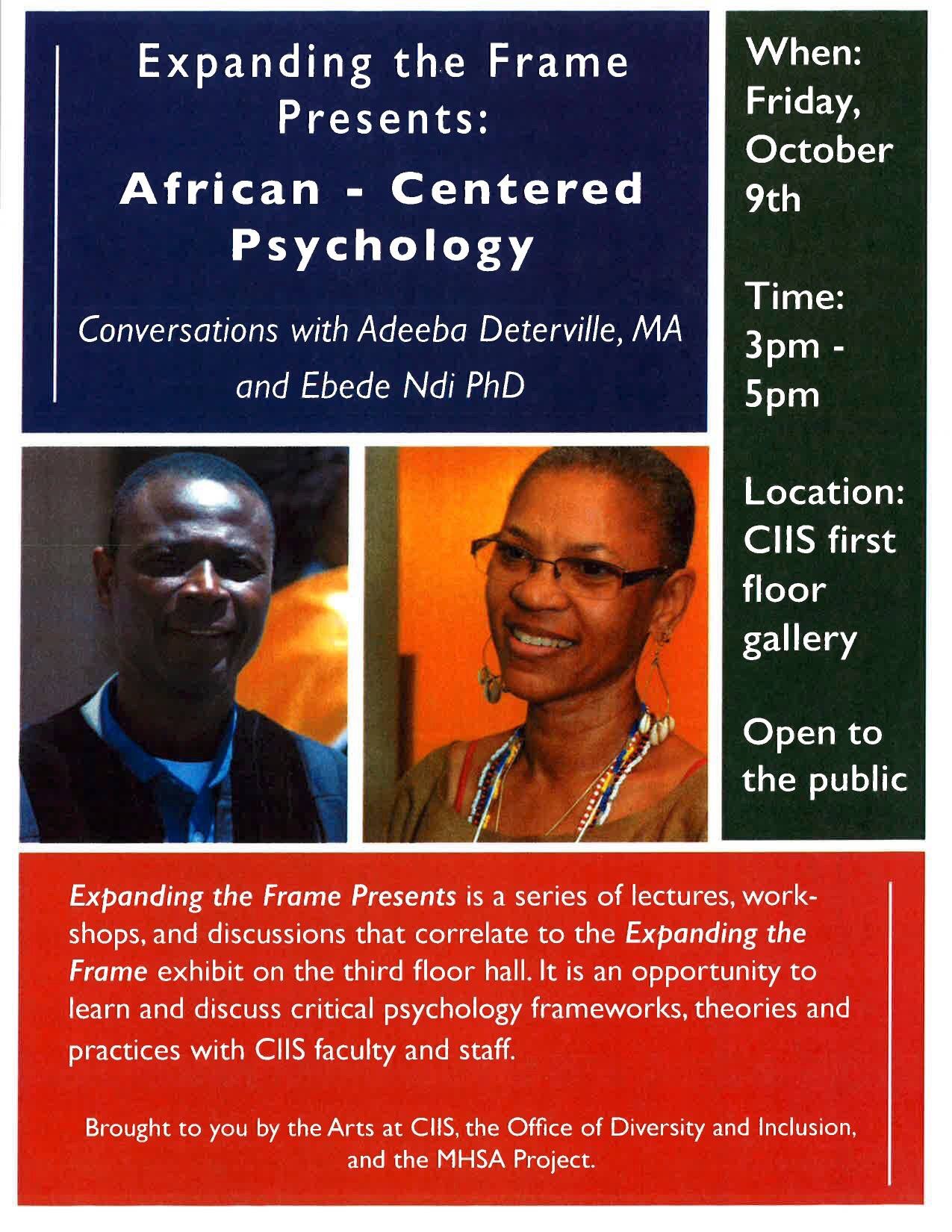
This informative webinar will provide an overview of resources available for African-centered research and how to apply an Afrocentric theoretical framework to your papers. Examples of journals, articles, and books will be provided. Information on African-centered organizations and conferences will be made available.
African/Black Psychology provides a holistic, optimal worldview from which to characterize Black cultural norm. It is the study of thoughts, behaviors, feelings, beliefs, attitudes, interactions, and well-being of Black people through an African-centered lens. Black Psychology is also a tool for which to view the soul through the principles of Ma’at, a spiritual code of conduct based on truth, justice, harmony, and balance.
African/Black psychology pre-dates Western psychology and provides Afrocentric models of study, therapy and interventions that can be applied in the social struggle for more humane environments. The contributions of early Black psychologists are often unacknowledged and excluded from mainstream academia and clinical training.
Adeeba Deterville, PhD student, Transformative Studies and MCP Program Coordinator has been a member of the Association of Black Psychologists for over twenty-years. Her areas of focus are African-centered Psychology and Spirituality, specifically cultural Identity development.
Beginning My Art of Money (AOM) 2015 Journey
- Be honest and open with myself and my household
- Set and keep healthy financial boundaries
- Save more. Spend less.
- Be open to receiving gifts and being supported
Africalogy – A Call for Inclusion
Reflecting over my past writing I realized that a thread that has run though them all is my call for the inclusion of the Afrocentric voice. I also noticed that my topic areas lean towards cultural identity development and spirituality, and fall within the fields of Psychology, Education, Spirituality, and, Ethnic Studies. Primarily, I have been drawn to study of psychology, however not traditional Western Psychology, but African-Centered Psychology. Unfortunately, there are limited options for graduate studies in African-centered Psychology; therefore I settled on transpersonal psychology and through my independent research brought in African-centered perspectives.
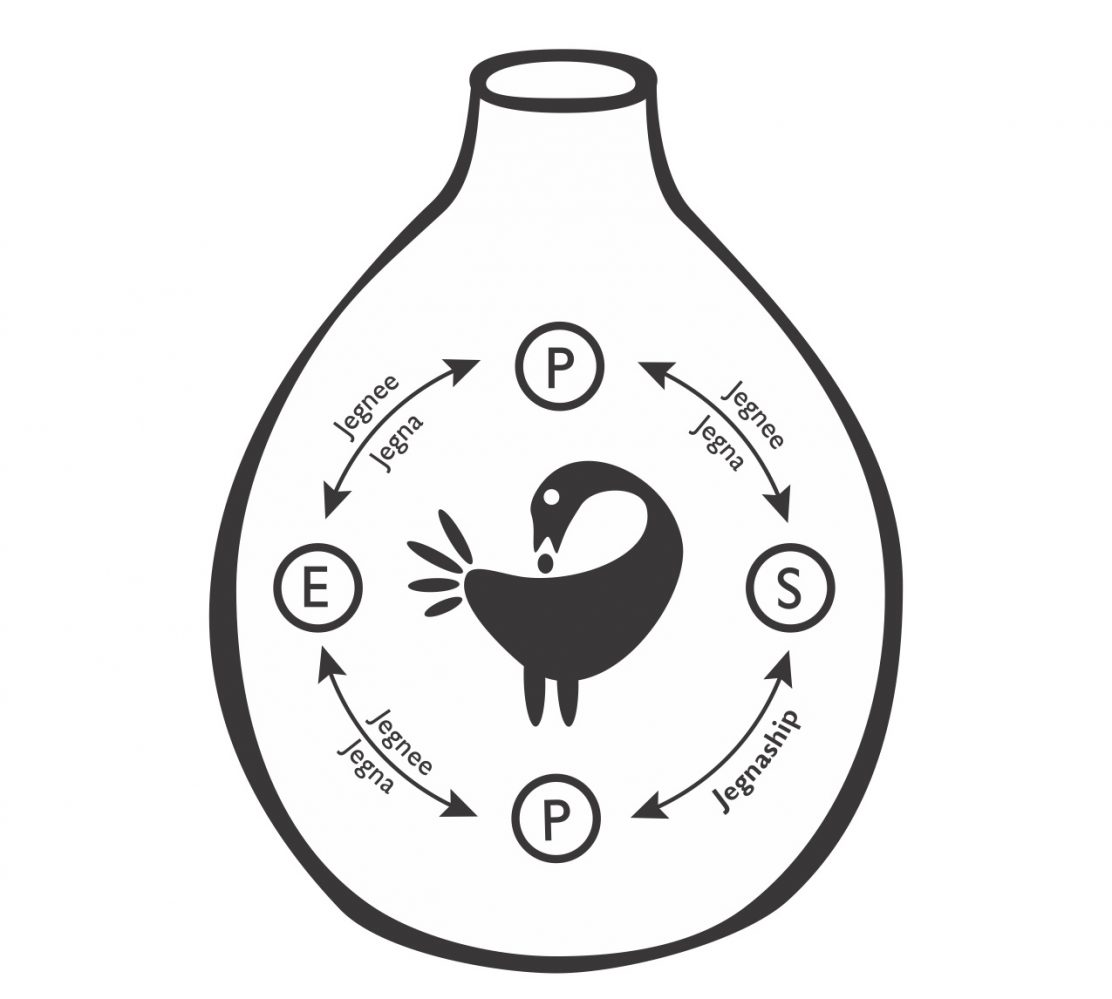
Throughout my graduate studies I have focused on the foundational theories of African-centered Psychology through the works of seminal authors including, Nobles (1986; 2006, 2013), Akbar (1994), the meta-theory Optimal Psychology by Myers (1993; 1993, 2013; 1991) and, Classical African/Black Studies by Karenga (1980; 1984, 1990, 1993; 1999; 2004). I have referenced their work in papers ranging from “African Spirituality and the Development of Self: Ori Ire and Black Identity Congruency” (Deterville, 2010); “Jung’s Theory of Individuation and its Relationship to the African Concept of Self and Consciousness” (Deterville, 2012), and “African-Centered Transpersonal Self in Diaspora and Psycho-spiritual Wellness: A Sankofa Perspective” (Deterville, 2014).
In making the shift from studying Psychology to the more general field of Transformation, I have struggled to find my footing. So when it came time to write a dissertation visioning paper I was at a bit of a lost – then to my joy, as I was researching the term Afrocentricity I came across an article that brings together a number of concepts that interest me – spirituality, cultural identity development, and African-centered perspectives in education discourse that address social transformation (Tolliver & Tisdell, 2002)
Tolliver and Tisdell (2002) brief literature review is an analysis of four disciplinary perspectives that address social transformation and psychology literature “including African-centered perspectives, community psychology, and identity development theory, and liberation theology”; in doing so, they offer definitions on each, beginning with spirituality and cultural identity development. This is of significance to my inquiry because spirituality – specifically African-centered spirituality has been a central topic in my graduate work. I realized in reading their article that in my call for the inclusion of the African-centered perspective and have begun to reference a number of articles that focused on Africalogy and graduate research.
Including:
- A Preliminary Report and Commentary on the Structure of Graduate Afrocentric Research and Implications for the Advancement of the Discipline of Africalogy, 1980-2004 (Bankole, 2006)
- Notes on Black Studies: Its Continuing Necessity in the Academy and Beyond (Christian, 2007)
- The Evolution Of Africology: An Afrocentric Appraisal (Conyers, 2004)
- Teaching community: A pedagogy of hope. (hooks, 2003)
- Research methods in Africana studies. (McDougal, 2014)
- The Place of Africalogy in the University Curriculum (Okafor, 1996)
- The Emergence of Sankofa Practice in the United States: A Modern History (Temple, 2010)
- Bridging Across Disciplines: Understanding the Connections Between Cultural Identity, Spirituality and Sociopolitical Development in Teaching for Transformation (Tolliver & Tisdell, 2002)
- Africentric Cultural Values, Psychological Help-Seeking Attitudes, and Self-Concealment in African American College Students (Wallace & Constantine, 2005)
In addition to Tolliver and Tisdell (2002) another article that directly speaks to my interests is Bankole (2006). She conducts a preliminary report and commentary on graduate research over a twenty-four year period of 1980- 2004 of the inclusion of Afrocentric research and its implication for the advancing the discipline of Africalogy. Bankole stated,
It is apparent that those doctoral candidates critically engaged in Africalogical research see themselves as members of a distinct academic discipline rather than operating from the margins of other disciplines in the academy. They not only met, and in some cases exceeded, the necessary requirements of the doctorate, they also, as Christian (2004), has articulated, have been compelled to defend their own discipline against various academic and nonacademic assaults. (Bankole, 2006, p. 694)
As a lifelong student of Black Studies and African-Centered Psychology I feel that it is my duty and joy to share the knowledge I have gained and to continue to deepen my understanding and application of the these theories. Recently I have found myself talking to a number of Black students and faculty that are struggling with the challenges of bringing culturally specific research into their scholarship. Over the years, to assist in my own development and that of other Black graduate students, I have been involved with a number of groups and activities, including hosting a monthly gathering of Black graduate students; serving as two-term Graduate Representative for the Student Circle of the Association of Black Psychologists; and participating on a number of committees at CIIS to help implement the President’s Diversity and Inclusion Initiative.
Although I don’t have a specific research question yet, I feel that I’m leaning towards deepening my knowledge and skills on African-centered transformative education. To that end, next year I plan to attend and present at a number of conferences on this topic including:
- Association of Black Psychologists (ABPsi) 47th Annual International Convention – Warrior-Healers Rise: A Call to Action to Reclaim, Resurrect and Restore the African Psyche.
- National Council for Black Studies (NCBS) 39th Annual Conference – The Foundation and Future of Black Studies: Reaffirming Our Emancipatory Mission & Value.
- National Conference on Race & Ethnicity in American Higher Education (NCORE) 28th Annual Conference.
My intention is that by the end of the year – I will have a clear inquiry focus and will be well on my way to developing my inquiry questions and how that knowledge will be applied to benefit of my community.
References
Akbar, N. (1994). Light from ancient Africa. Tallahassee: Mind Productions & Associates, Inc.
Bankole, K. O. (2006). A preliminary report and commentary on the structure of graduate afrocentric research and implications for the advancement of the discipline of africalogy, 1980-2004. Journal of Black Studies, 36(5), 663-697. doi: 10.1177/0021934705285938
Christian, M. (2007). Notes on Black Studies: Its Continuing Necessity in the Academy and Beyond. Journal of Black Studies, 37(3), 348-364. doi: 10.1177/0021934706290078
Conyers, J. L. (2004). The Evolution Of Africology: An Afrocentric Appraisal. Journal of Black Studies, 34(5), 640-652. doi: 10.1177/0021934703259257
Deterville, A. (2010). African sprituality and the development of self: Ori ire and Black identity congruency. Essay. BAC, Cohort B. California Institute of Integral Studies.
Deterville, A. (2012). Jung’s theory of individuation and its relationship to the African concept of self and consciousness. Essay. Theories of Personality. Insititute of Transpersonal Psychology. Palo Alto, CA.
Deterville, A. (2014). African-centered transpersoanl self in diaspora and psycho-spititual wellness: A sankofa perspective. Scholarly Writing for Publications. Institute of Transpersonal Psychology.
hooks, b. (2003). Teaching community: A pedagogy of hope. New York, NY: Routledge.
Karenga, M. (1980). Kawaida Theory: An Introductory Outline. Inglewood: Kawaida Publications.
Karenga, M. (1984). Selections from the Husia: Sacred Wisdom of Ancient Egypt. Los Angeles: The Univerity of Sankore Press.
Karenga, M. (1990). The Book of Coming Forth by Day: The Ethics of the Declarations of Innocence. Los Angeles: The University of Sankore Press.
Karenga, M. (1993). Introduction to Black Studies. Los Angeles, CA: University of Sankore Press.
Karenga, M. (1999). Odù Ifá: The Ethical Teachings Translation and Commentary, A Kawaida Interpretation. Los Angeles: University of Sankore Press.
Karenga, M. (2004). Maat: The moral ideal in ancient Egypt: A study in classical African Ethics: Routledge New York & London.
McDougal, S., III. (2014). Research methods in Africana studies. New York, NY: Peter Lang Publishing, Inc.
Myers, L. J. (1993). Optimal psychology and the transpersonal paradigm Understanding an afrocentric world view: Introduction to an optimal psychology (pp. 31-37). Dubuque: Kendall/Hunt.
Myers, L. J. (1993). Understanding an Afrocentric world view: Introduction to an optimal psychology (2nd ed.). Dubuque, IA: Kendall/Hunt Publishing Company.
Myers, L. J. (2013). Restoration of Spirit: An African-Centered Communal Health Model. Journal of Black Psychology, 39(3), 257-260. doi: 10.1177/0095798413478080
Myers, L. J., Speight, S. L., Highlen, P. S., Cox, C. I., Reynolds, A. L., Adams, E. M., & Hanley, C. P. (1991). Identity Development and Worldview: Toward an Optimal Conceptualization. Journal of Counseling and Development : JCD, 70(1).
Nobles, W. (1986). African psychology: Toward its reclamation, reascension & revitalization. Oakland: A Black Family Institute Publication.
Nobles, W. W. (2006). Seeking the sakhu : foundational writings for an African psychology. Chicago: Third World Press.
Nobles, W. W. (2013). Shattered Consciousness, Fractured Identity: Black Psychology and the Restoration of the African Psyche. Journal of Black Psychology, 39(3), 232-242. doi: 10.1177/0095798413478075
Okafor, V. O. (1996). The Place of Africalogy in the University Curriculum. Journal of Black Studies, 26(6), 688-712. doi: 10.1177/002193479602600603
Temple, C. N. (2010). The Emergence of Sankofa Practice in the United States: A Modern History. Journal of Black Studies, 41(1), 127-150. doi: 10.1177/0021934709332464
Tolliver, D., & Tisdell, E. J. (2002). Bridging Across Disciplines: Understanding the Connections Between Cultural Identity, Spirituality and Sociopolitical Development in Teaching for Transformation.
Wallace, B. C., & Constantine, M. G. (2005). Africentric cultural values, psychological help-seeking attitudes, and self-concealment in African American college students. Journal of Black Psychology, 31(4), 369-385.
In the ebb and flow of life
As I approach my 52nd birthday, I have been reflecting on the waves that have carried me thus far. There are aspects of my life that feel like they have been looping around in an unrelenting swirl: my desire for material comfort, the size of my jeans, and the balance in my checking account. There are other aspects that are relaxing happily on the shore: my marriage, family, and friends, acceptance of my limitations and strengths, and my love for the finer things of life – food, wine, Eileen Fisher, and spa treatments.
Although I still struggle with the pull the under currents of money, career, and school- I feel that with each passing year I become more and more comfortable voyage.
I aspire to be like the image of Yemaya with her head high above the waves, floating with ease on the currents.Stable and steady in my gaze, laid back and fluid in my actions.
Time Management for College Students
You’ve decided to go to college, you’ve chosen your major, registered for classes, purchased the textbooks, notebooks, and pencils. Off to class you go. Week one, life is grand, you completed your assignment — on time. By week three you begin to struggle just a little. You make the deadlines, but just barely. By week six, if you have hair, you may have started to loose some of it – you’re two assignments behind in your English class, barely keeping up in Calculus, and you hope to be able to sleep sometime between History 102 and Philosophy 101.“Even if you are on the right track, you’ll get run over if you just sit there” – Will Rogers
This quote has happened to many college students, myself included. What’s a student to do? Help is on the way…Time Management.
Each of us has a valuable resource — time. We in western society regulate time on a 24 hour clock. One week contains 168 hours. It doesn’t take an Einstein to figure out that if you have 168 hours of time and 180 hours of work, something is not going to get done. Likewise, you could have 100 hours of work, and still not complete it. Time management is what you need.
Time management is you taking control of your time. It requires self analysis, a written plan, and discipline. Self analysis is used to see where you are currently spending your time. How much time are you wasting, and how much time is spent doing low priority tasks. For example, how much time do you spend getting dressed in the morning? Could you spend more time improving your grades if you spent less time looking for what shoes to wear? How many hours do you sleep each day: eight, ten, twelve? Could train your body to require less sleep through proper exercise and meditation, to say five or six per night, then use those “extra” ten hours per week at the library or in a study group.
To find out where you are currently using your time, monitor it for one week by writing down everything you do. Write what time you start and end every task of the day, and be honest. For example: 7:00am – got up, 7:15am – ate breakfast and dressed for work, 8:00am – left for work, 6:00pm – returned home, 6:15pm – watched TV and ate take-out Chinese food, 9:00pm – read school assignment, 11:00pm – went to bed. Analyze this data, see where you could have used your time more effectively. Decide what areas can be reduced and what areas need more time.
Next create a written plan and develop a day planner. You can create your own or purchase one form an office supply or campus bookstore. Two of my favorites are Franklin/Covey Planner and Moleskine. In your planner, schedule a time for every task, even the givens such as dressing, eating, and sleeping. Remember to schedule in relax/fun time. Spending time with friends and family is vital to a successful time management plan (this is where honesty comes into play). Include all seven days of the week. Maybe on Saturdays you can schedule maintenance tasks like filling up the gas tank, washing your clothes, review your financial budget. It’s important to understand how all 168 hours are being allocated. Identify time wasters and eliminate therm. For fun, visualize each time waster as a wicked cartoon character, and yourself as the superhero; it’s your mission to find and eliminate the evil time wasters in the Timeland.
You’ll be surprised at how time management helps to improve your level of concentration. By eliminating distractions and having nothing else to do but what you are doing, you are then able to focus your energy, causing highly successful results. Finally, what it all comes down to is a little thing called self-discipline. Planning is vital to time management, but action is what causes it to work. You can go to a professional time management consultant, even pay hundreds of dollars on the newest planning system; but if you don’t have the self-discipline to DO IT you might as well stay in bed.
The only time to do anything is now. You can think about doing something next Wednesday. You can write about doing something next Wednesday. You can daydream, discuss, ruminate, speculate, or fantasize about what you will do next Wednesday. But it won’t actually get done if you don’t DO IT on Wednesday.
Remnants of a Past Life
In 2007 I stepped away from a career that I had been building for nearly twenty-years. This career path had culminated in a six-figure position in the corporate offices of one of the largest financial institutions in the United States. In my personal life, I was responsible for mortgage payments on a half-a-million dollar loft, car payments, credit card payments, homeowner association dues, professional organization dues and more. My monthly expenses were averaging $6000. I also had panic attacks, migraines and nightmares.
But even after walking away from the bank, I continued to try to carry it all. For two more years, I did consulting work which paid the bills for a bit, but by the end of 2009 I was suffering from severe exhaustion, the bills had falling behind, and I had gained fifty-pounds. So, I called all the creditors; the mortgage company, the credit union, the credit card companies, and my bankruptcy attorney. Freedom was at hand.
Moving into a lovely one-bedroom apartment required a lot of downsizing. But instead of letting go of all that didn’t fit into this new reduced sized life – I got a storage unit. For five-years at an average cost of two-hundred and five dollars per month which comes to around $15,000 I have been holding on to the remnants of my past life. This weekend, I sorted through the dusty storage unit and faced the ghosts of my past.
I was able to fill three trash boxes with mounds of documents from my banking and non-profit management career, I released three boxes of design, management, and fiction books that will be sold or donated. I released six pairs of shoes, a trunk of office supplies, a huge box of party supplies (disposable forks, serving plates, cups, bowls). Over the next few days many of these items will find new homes.
I kept a few things, the certificates of appreciation and recognition, the family pictures from my old desk, a few African decor design books, a leather duffle bag that I used to move to Oakland in 1997.
With the emptying of the storage space, I am truly free of the burdens of the past. I am now able to fully live in the present. Unburden.
The Six Figure Woman Affirmation
I am a financially independent woman, one who is at ease with abundance and receptive to the freedom it brings. I have the wherewithal needed for sculpting my life, as well as the betterment humanity. By me doing my part, collectively women will have the resources, values, vision and sensitivity to change the world, to heal the planet. I understand that women are the future of man. As a Successful High Earner, I empower myself.
I am undeniably a powerful person. I no longer “water myself down.” I see my work is all about relationships. It’s a wf by living life on my own terms, finding pleasure in my work, in my relationships and the opportunities I have to serve my community. I am powerful because I do what I love doing. I am able to help pay of serving others, its part of my happiness. I’ve found ways to be of service that I’d never dreamed of and I’m getting paid handsomely for it. I have the best of both worlds. I understand that my state of mind determines my level of success. I have lots of faith in myself. I have the power of my thoughts to create my reality. I am a conscious spender and a disciplined saver. I am NOW living the life that I imagined. I have answered the call to the higher work of wealth. I let go of the fear of success. I do what is right for me and the Universe supplies. eople and make money too. I am a woman who uses her money to pursue her dreams, live out her values, and make an impact on others.
I Adeeba D Deterville, and I release the extraordinary buried inside and I awaken to the Goddess within. I commit to expand my potential, become all I can be, create more abundance, and share it with others. I am the transformative force that I was meant to be. I am a six-figure woman. I am a powerful woman. I work in the six-figure sector. I am a Successful High Earner. I have declared my intention. I am willing to let go of fear. I stretch – I am audacious. I seek and find support.
I…Spend Less • Save More • Invest Wisely • Give Generously.
I know that… It’s possible • It doesn’t mean working all the time • I can fulfill my values • I love what I do • I feel the fear and go for it anyway • I have a workable equilibrium • I have a good laugh • I appreciate abundance.
I have… Audacity • Resilience • Encouragement • Self-Awareness • Non-attachment • Financial know-how
And so it is. Ori Ire.
Sankofa Wellness Poster Presentation 2012

Black Graduates in Psychology Conference – Loyola Marymount University
Mindfulness, Discernment, Compassion, and Appreciation of Differences
Slide presentation for Integral Research Skills class