Reflecting over my past writing I realized that a thread that has run though them all is my call for the inclusion of the Afrocentric voice. I also noticed that my topic areas lean towards cultural identity development and spirituality, and fall within the fields of Psychology, Education, Spirituality, and, Ethnic Studies. Primarily, I have been drawn to study of psychology, however not traditional Western Psychology, but African-Centered Psychology. Unfortunately, there are limited options for graduate studies in African-centered Psychology; therefore I settled on transpersonal psychology and through my independent research brought in African-centered perspectives.
Throughout my graduate studies I have focused on the foundational theories of African-centered Psychology through the works of seminal authors including, Nobles (1986; 2006, 2013), Akbar (1994), the meta-theory Optimal Psychology by Myers (1993; 1993, 2013; 1991) and, Classical African/Black Studies by Karenga (1980; 1984, 1990, 1993; 1999; 2004). I have referenced their work in papers ranging from “African Spirituality and the Development of Self: Ori Ire and Black Identity Congruency” (Deterville, 2010); “Jung’s Theory of Individuation and its Relationship to the African Concept of Self and Consciousness” (Deterville, 2012), and “African-Centered Transpersonal Self in Diaspora and Psycho-spiritual Wellness: A Sankofa Perspective” (Deterville, 2014).
In making the shift from studying Psychology to the more general field of Transformation, I have struggled to find my footing. So when it came time to write a dissertation visioning paper I was at a bit of a lost – then to my joy, as I was researching the term Afrocentricity I came across an article that brings together a number of concepts that interest me – spirituality, cultural identity development, and African-centered perspectives in education discourse that address social transformation (Tolliver & Tisdell, 2002)
Tolliver and Tisdell (2002) brief literature review is an analysis of four disciplinary perspectives that address social transformation and psychology literature “including African-centered perspectives, community psychology, and identity development theory, and liberation theology”; in doing so, they offer definitions on each, beginning with spirituality and cultural identity development. This is of significance to my inquiry because spirituality – specifically African-centered spirituality has been a central topic in my graduate work. I realized in reading their article that in my call for the inclusion of the African-centered perspective and have begun to reference a number of articles that focused on Africalogy and graduate research.
Including:
- A Preliminary Report and Commentary on the Structure of Graduate Afrocentric Research and Implications for the Advancement of the Discipline of Africalogy, 1980-2004 (Bankole, 2006)
- Notes on Black Studies: Its Continuing Necessity in the Academy and Beyond (Christian, 2007)
- The Evolution Of Africology: An Afrocentric Appraisal (Conyers, 2004)
- Teaching community: A pedagogy of hope. (hooks, 2003)
- Research methods in Africana studies. (McDougal, 2014)
- The Place of Africalogy in the University Curriculum (Okafor, 1996)
- The Emergence of Sankofa Practice in the United States: A Modern History (Temple, 2010)
- Bridging Across Disciplines: Understanding the Connections Between Cultural Identity, Spirituality and Sociopolitical Development in Teaching for Transformation (Tolliver & Tisdell, 2002)
- Africentric Cultural Values, Psychological Help-Seeking Attitudes, and Self-Concealment in African American College Students (Wallace & Constantine, 2005)
In addition to Tolliver and Tisdell (2002) another article that directly speaks to my interests is Bankole (2006). She conducts a preliminary report and commentary on graduate research over a twenty-four year period of 1980- 2004 of the inclusion of Afrocentric research and its implication for the advancing the discipline of Africalogy. Bankole stated,
It is apparent that those doctoral candidates critically engaged in Africalogical research see themselves as members of a distinct academic discipline rather than operating from the margins of other disciplines in the academy. They not only met, and in some cases exceeded, the necessary requirements of the doctorate, they also, as Christian (2004), has articulated, have been compelled to defend their own discipline against various academic and nonacademic assaults. (Bankole, 2006, p. 694)
As a lifelong student of Black Studies and African-Centered Psychology I feel that it is my duty and joy to share the knowledge I have gained and to continue to deepen my understanding and application of the these theories. Recently I have found myself talking to a number of Black students and faculty that are struggling with the challenges of bringing culturally specific research into their scholarship. Over the years, to assist in my own development and that of other Black graduate students, I have been involved with a number of groups and activities, including hosting a monthly gathering of Black graduate students; serving as two-term Graduate Representative for the Student Circle of the Association of Black Psychologists; and participating on a number of committees at CIIS to help implement the President’s Diversity and Inclusion Initiative.
Although I don’t have a specific research question yet, I feel that I’m leaning towards deepening my knowledge and skills on African-centered transformative education. To that end, next year I plan to attend and present at a number of conferences on this topic including:
- Association of Black Psychologists (ABPsi) 47th Annual International Convention – Warrior-Healers Rise: A Call to Action to Reclaim, Resurrect and Restore the African Psyche.
- National Council for Black Studies (NCBS) 39th Annual Conference – The Foundation and Future of Black Studies: Reaffirming Our Emancipatory Mission & Value.
- National Conference on Race & Ethnicity in American Higher Education (NCORE) 28th Annual Conference.
My intention is that by the end of the year – I will have a clear inquiry focus and will be well on my way to developing my inquiry questions and how that knowledge will be applied to benefit of my community.
References
Akbar, N. (1994). Light from ancient Africa. Tallahassee: Mind Productions & Associates, Inc.
Bankole, K. O. (2006). A preliminary report and commentary on the structure of graduate afrocentric research and implications for the advancement of the discipline of africalogy, 1980-2004. Journal of Black Studies, 36(5), 663-697. doi: 10.1177/0021934705285938
Christian, M. (2007). Notes on Black Studies: Its Continuing Necessity in the Academy and Beyond. Journal of Black Studies, 37(3), 348-364. doi: 10.1177/0021934706290078
Conyers, J. L. (2004). The Evolution Of Africology: An Afrocentric Appraisal. Journal of Black Studies, 34(5), 640-652. doi: 10.1177/0021934703259257
Deterville, A. (2010). African sprituality and the development of self: Ori ire and Black identity congruency. Essay. BAC, Cohort B. California Institute of Integral Studies.
Deterville, A. (2012). Jung’s theory of individuation and its relationship to the African concept of self and consciousness. Essay. Theories of Personality. Insititute of Transpersonal Psychology. Palo Alto, CA.
Deterville, A. (2014). African-centered transpersoanl self in diaspora and psycho-spititual wellness: A sankofa perspective. Scholarly Writing for Publications. Institute of Transpersonal Psychology.
hooks, b. (2003). Teaching community: A pedagogy of hope. New York, NY: Routledge.
Karenga, M. (1980). Kawaida Theory: An Introductory Outline. Inglewood: Kawaida Publications.
Karenga, M. (1984). Selections from the Husia: Sacred Wisdom of Ancient Egypt. Los Angeles: The Univerity of Sankore Press.
Karenga, M. (1990). The Book of Coming Forth by Day: The Ethics of the Declarations of Innocence. Los Angeles: The University of Sankore Press.
Karenga, M. (1993). Introduction to Black Studies. Los Angeles, CA: University of Sankore Press.
Karenga, M. (1999). Odù Ifá: The Ethical Teachings Translation and Commentary, A Kawaida Interpretation. Los Angeles: University of Sankore Press.
Karenga, M. (2004). Maat: The moral ideal in ancient Egypt: A study in classical African Ethics: Routledge New York & London.
McDougal, S., III. (2014). Research methods in Africana studies. New York, NY: Peter Lang Publishing, Inc.
Myers, L. J. (1993). Optimal psychology and the transpersonal paradigm Understanding an afrocentric world view: Introduction to an optimal psychology (pp. 31-37). Dubuque: Kendall/Hunt.
Myers, L. J. (1993). Understanding an Afrocentric world view: Introduction to an optimal psychology (2nd ed.). Dubuque, IA: Kendall/Hunt Publishing Company.
Myers, L. J. (2013). Restoration of Spirit: An African-Centered Communal Health Model. Journal of Black Psychology, 39(3), 257-260. doi: 10.1177/0095798413478080
Myers, L. J., Speight, S. L., Highlen, P. S., Cox, C. I., Reynolds, A. L., Adams, E. M., & Hanley, C. P. (1991). Identity Development and Worldview: Toward an Optimal Conceptualization. Journal of Counseling and Development : JCD, 70(1).
Nobles, W. (1986). African psychology: Toward its reclamation, reascension & revitalization. Oakland: A Black Family Institute Publication.
Nobles, W. W. (2006). Seeking the sakhu : foundational writings for an African psychology. Chicago: Third World Press.
Nobles, W. W. (2013). Shattered Consciousness, Fractured Identity: Black Psychology and the Restoration of the African Psyche. Journal of Black Psychology, 39(3), 232-242. doi: 10.1177/0095798413478075
Okafor, V. O. (1996). The Place of Africalogy in the University Curriculum. Journal of Black Studies, 26(6), 688-712. doi: 10.1177/002193479602600603
Temple, C. N. (2010). The Emergence of Sankofa Practice in the United States: A Modern History. Journal of Black Studies, 41(1), 127-150. doi: 10.1177/0021934709332464
Tolliver, D., & Tisdell, E. J. (2002). Bridging Across Disciplines: Understanding the Connections Between Cultural Identity, Spirituality and Sociopolitical Development in Teaching for Transformation.
Wallace, B. C., & Constantine, M. G. (2005). Africentric cultural values, psychological help-seeking attitudes, and self-concealment in African American college students. Journal of Black Psychology, 31(4), 369-385.

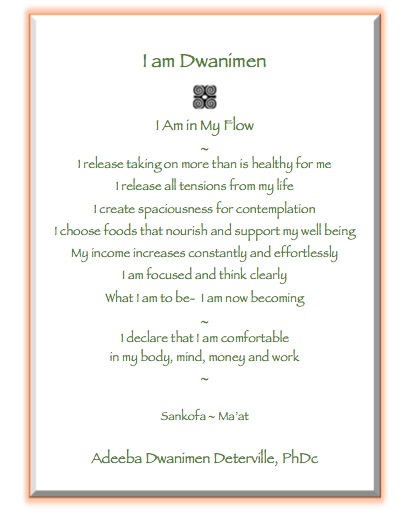
 At the beginning of each season I set my intention for what I want to manifest. It’s a three-step process I learned from my wellness coach Asara Tsehai.